Lotta good books out there this week. Fifteen books this week, if my count is right (I have to temper it with that all the time because I've been burned before). There's been a weird lull lately of non-20 book weeks. I'll be honest, I'm not complaining. I love reading comics but reviewing five books a day while also attempting to perform as an adult human is occasionally taxing. But this is the world and I'm complaining about self-inflicted writing about books I tend to like far more than I tend to dislike. Maybe if I could stop myself from writing essays on each book I'd be in better shape. Maybe.
A+X 8
I don't tend to put these books (or books like them) on my "most anticipated" lists for the simple reason that I don't tend to anticipate them. They are what they are and I don't begrudge them that. They're fun little one-off books but they're not typically much for plot or hugely for character building. That said, I'm pretty excited about this book if just for half of it. I'm not completely thrilled for the first half, which is a Spider-Woman and Kitty Pryde team up written by Deadpool co-writer Gerry Duggan. I'm not really a fan of Spider-Woman (though I've grown fonder of her with DeConnick's take) and I'm not a fan of the new Deadpool series. I am, though, still a big fan of Deadpool and Dr. McNinja writer Christopher Hastings (who wrote the Deadpool mini for Fear Itself as well) will team Deadpool with Hawkeye for his half of the story. I'm pretty excited about that one.
Avengers 12
This book just keeps building and building. I don't know if I've mentioned it here before (I think I may have last week, or I may have just been thinking about it a lot) but Kelly Sue DeConnick says that Hickman is capable of planning in four year blocks for his stories. It makes total sense (and the more I write down, the more I remember having already written that at some point) and this story feels like something along those lines. When I said this to one of the guys at my comic shop, he said that he'd be surprised if Hickman stayed on the book for four years; guys like that tend to move around and are usually in the Marvel game to prop up their creator-owned books. That's not untrue and it's not anything to hold against Hickman (whose CO stuff I should really be reading) but that doesn't change the fact that this series feels like a long game. That doesn't mean the immediate stuff is worth skipping; quite the opposite in fact. These kinds of long term things tend to be most rewarding after reading everything and this book has been really good already.
Daredevil 26
Geez, what's not to recommend about this book right now? Matty's up to his neck in stress and now he has to deal with a mysterious hired gun who has all of Matt's powers but isn't blind (and knows Matt is)? There's definitely worrying stuff all over the horizon if not closer for Matt Murdock and I swear at some point his Shadowland past will catch up to him, you just watch. I mean, it has to, right? It was pretty crazy.
Superior Spider-Man 10
After last issue's somewhat shocking reveal that Doc Ock figured out Peter's memories were gaining sentience and that Peter had a chance of coming back, he snuffed out the problem and seems ready to move on and away from it. We're all comic book readers here so we all expected Peter to come back, maybe even sooner than this would have been. Could Doc Ock really have taken out the last chance for Peter Parker's return? Probably not, but it's worth thinking about. Just like the most intriguing question in Marvel right now might just be "Is Doc Ock a superior Spider-Man?"
Young Avengers 5
Even if Kieron Gillen and Jamie McKelvie weren't crafting an exquisite book right now, with an enticing plot, superb characters, clever writing, and gorgeous art, the plot twist of "Loki has reality-altering powers" should be enough of a draw for any reader. That's Loki, god of mischief and decidedly sinister, with powers spawned from the lady who once decimated the mutants by saying words. Not even particularly difficult to say words, just words. Sure, Billy's powers might not be quite up to his mom's standards yet but he also doesn't know how to use them. Loki doesn't have the level of power Billy has (right now, anyway) but he sure has the experience Billy lacks with powers. Now we have to see if Loki fulfills his promise to help them or if he simply doesn't return to the team. Maybe more than that, though, is what he'll do with the powers now that he has them. Extinguish the curse, sure. But he's got ten whole minutes with those powers. You think that's all he's going to do?
Tuesday, May 21, 2013

Monday, May 20, 2013
Marvel cancels Gambit, Red She-Hulk
Marvel cancels Gambit after issue 17
 As I said in this week's review of Gambit, I do think that the book is finding its footing. The next few issues will still go on to prove or disprove that but sadly for fans of the most charismatic X-Man, it won't particularly matter at that point. By and large I don't think the book was doing anything far off from what's being done in other books, aside from focusing on Gambit, but that didn't make it a bad book by any means. Asmus had a feel for the character and Clay Mann had solid artwork and it's always sad to see a pretty good book go down. However, Gambit books never do seem to last and it seems harder and harder for solo books to gain traction these days. If anything was giving James Asmus and co. hope, it should probably have been Fraction's Hawkeye book, which was a solo title for a character that never can sustain a solo title but, instead of being cancelled, it's gotten huge critical acclaim and seems to sell really well. Hawkeye doesn't feel like a superhero comic, though. Clint also doesn't feel like a superhero or even much of a hero in it either. Gambit toed the line between heist book and thief book and all sorts of other things on that spectrum but, at the end of the day, it still felt like Gambit was a superhero and was doing things to be a hero. Even when he was stealing from people, it was stealing from the rich, clearly bad guys. Again, I don't want to infer that being a superhero book was a poor decision for this title because I don't think it was. I don't know where else you go with this character and I sure don't know enough Gambit history to tell anyone what to do with him. It is risky though, in this day and age where Marvel releases loads of books, to sustain one title about a less popular character (less popular than someone like Cap or Iron Man or Thor) and have it feel like another superhero book. Readers can lose interest in that and you're typically starting off with a smaller base anyway so reader loyalty is hugely important. Still, sad to see this one go, if only because I rather like Asmus. For other fans of Asmus, you should know he'll lead a book called "Quantum and Woody" for Valiant, starting in July. The little promotional poster I got from my local comic book store seems to feature a goat on it, so keep an eye on that title.
Marvel cancels Red She-Hulk after issue 67
 Surprising no one whose read the blog except for me, this cancellation stings a bit more. Despite my feelings on Hulk books in general at the time (now I think Red Hulk ranks lowest for me by a pretty wide margin, and that's where this book kind of spawned from), I've found myself engrossed in the story and loving the main characters throughout this run. One of the upsides and also downfalls of Hulk throughout his history is that he's the ultimate Jekyll and Hyde but his change is so drastic that it rarely allows for breaks in the plot. What I'm trying to say is that Hulk is so clearly not Bruce Banner (unless we're talking about one of the several runs where Hulk gains intelligence or Banner gains access to Hulk while keeping his own mind) and they're either kept very separate (to the point of we only see Hulk or only see Banner ever) or they're fighting one another. It limits the amount of plots you can have and it limits how much you can connect with your main character if he's constantly afraid of a green monster coming out of him or if he's constantly a green monster. With the She-Hulks, though, they've both found a way to temper their Hulk state and keep it at a more human-like appearance and a more regular brain state. What I'm getting at in a very long-winded way is that I appreciate the fact that we can understand our main character and her motivations and that she's rather fun to be around. She's still enough different from the human Betty Ross that we know the transformation is more than purely physical, but there's still enough Betty left in her to drive the story and the character. We also got the revelation that the She-Hulks, at least Red, can hulk out even further than they have, which is an interesting turn. Add to all this character stuff that there's a compelling story with a somewhat mysterious villain in General Fortean, an upcoming appearance by She-Hulk, incredibly old machinations by SHIELD and Nicola Tesla himself, and one of the best support characters I've seen re-emerge in recent days in X-51 and this has been a monumentally fun and interesting book that felt different than most other books out there. Sadly, for all my talk above about how Gambit wasn't quite different enough to succeed, Red She-Hulk was a little too different to succeed. She's also a character who isn't popular enough to really sustain readership and the comic wasn't featuring huge guest stars and was featuring Nicola Tesla and a machine that can see the future and possibly make the world run. They were fighting an uphill battle all the way (most of the series that have been cancelled in recent days I've read while saying "geez, I can't believe this is still a series." Not to say they didn't deserve to be, just to say that they didn't quite fit the "successful series" bill). Still, I'm far more sad about this than I would have expected to be just a few months ago. Another solid book down, I suppose.

Marvel cancels Red She-Hulk after issue 67

Sunday, May 19, 2013
This week's picks
This is a bit of an interesting week for me as none of my standbys were out. I'm not saying that's a bad thing; there are tons of great books out there from Marvel and I don't love that my chosen picks are always from the same well of series but I can't help what I find best, I suppose. It's nice, though, to be able to spotlight other books for a change, even if one of them is just a one shot for an event that features a book/writer I do always pick.
Avengers: The Enemy Within 1
 Obviously it helps a great deal to have an event focused on a character and/or going between a couple books if the author of the event is the same author behind that character/those books. What I'm trying to say is that Kelly Sue DeConnick has a perfect handle on Carol and on the way she acts and the troubles she faces. Add to that an intriguing story and the promise of more characters showing up and you have a great event starter in Enemy Within. In my review, I didn't even touch on Carol's fear that she'll start hallucinating as Helen reportedly did (though Helen may actually have been transported through time, jury's still out). On top of that, DeConnick has done something no other writer has ever been able to do: made me enjoy reading Spider-Woman. There's plenty to think about going forward with this arc and I'm confident that the event will be a solid one.
FF 7
 Incredibly sweet story that serves many purposes as far as this pretty young series goes. Scott steps into the leader role and away, if only a little bit, from the overprotective and fearful father role. The FF comes together as a famiy. Darla shows her chops and fights as hard as anyone else out there. The story itself is resolved and Medusa is freed from the Wizard's control. Bentley-23 fights for the FF and sends Blastaar into his recent story with the Fantastic Four. All in one issue. It's emotionally satisfying to watch Scott take charge and show himself as not too in over his head. It's a nice wrap-up for this arc while still giving ample opportunities to expand later. Add to that the promise of Doom sooner or later and FF seems to be in pretty good shape.
Iron Man 10
 We've already had the surprise that 451 was working alongside Howard Stark in some capacity but this issue does a good job to not rest on that secret. Gillen isn't afraid to delve into places in Tony's history that other writers haven't gone. Given the popularity of the character right now particularly, that isn't a lightly made decision, I'm sure. Tony should have been dead in the womb or just out of it. Somehow he didn't die and somehow it has to do with his father making some sort of deal or something with 451, a somewhat nefarious robot whose true goal hasn't really been revealed yet. Is he the fact-gatherer who is sincerely trying to make the best out of bad situations or is he more sinister than that? I guess we'll have to keep reading to find out. That doesn't even mention the fact that Gillen and Eaglesham put in a full-on heist in about five pages and it's interesting and well-executed while keep up the fun of heist movies and the like. Solid issue and a great launching point for the arc.
Best Panel:
 I had far less trouble than I should have had picking this week's panel. We had Cable and his X-Force in space, we had Carol Danvers punching out dinosaurs, we had Gambit with a jetpack, we had Venom shielding an explosion, we had Scott Lang looking into the Negative Zone and saying "What." (Fun fact: I will always giggle at "what" not asked as a question. Hilarious every time). However, we also had two dogs with goggles to protect their eyes from explosion debris. So should I have maybe gone with something different here? There's a chance. Was I ever going to? Nope.
Avengers: The Enemy Within 1

FF 7

Iron Man 10

Best Panel:
 I had far less trouble than I should have had picking this week's panel. We had Cable and his X-Force in space, we had Carol Danvers punching out dinosaurs, we had Gambit with a jetpack, we had Venom shielding an explosion, we had Scott Lang looking into the Negative Zone and saying "What." (Fun fact: I will always giggle at "what" not asked as a question. Hilarious every time). However, we also had two dogs with goggles to protect their eyes from explosion debris. So should I have maybe gone with something different here? There's a chance. Was I ever going to? Nope.
Saturday, May 18, 2013
Nova 4, Ultimate Spider-Man 23, Wolverine MAX 7
Nova 4
Loeb (w) and McGuinness and Vines (a) and Gracia (c)
 Finding himself faced off against a fleet of Chitauri ships with no way to really scout, Nova attacks head on, going after the mothership first. He is quickly stopped, though, as he crashes through to find Titus, former Black Nova and friend of his father, now aligned with the Chitauri. Titus tells the story that the audience saw in the very first issue, about Jesse being sent home for the birth of his son and to find reinforcements, only Titus tells a different story. In his version, Jesse abandons them there and leaves them squared off against Chitauri all by themselves. Titus bargains with them, offering the Rigellian recorder for his life. With the recorder, they've built an Ultimate Nullifier. Titus also says that he fought and killed Jesse just a week ago. Sam refuses to believe him and manages to escape and snag the Nullifier on his way out. He blasts back home still without word from Gamora or Rocket and returns to his house to hide the Nullifier and wait for the Guardians. When someone appears, he goes to investigate, only to find Titus there, threatening his home.
Usually I dive right into my analysis of a comic. By the time I've finished reading and summarizing a comic, I'm ready to talk about it. Sometimes I'm not because I really need to let it sink in and I need to give my brain a chance to process everything. That's happened with Uncanny Avengers before, where I needed time to get through the darkness. Typically in that situation, I won't even start the review until I've had time to make my way through it all. However, I'm kind of stumped for things to say here, and not in a "I need time to process because I'm so blown away" kind of way. As I've kind of hinted at in the last few reviews for this book, I think that these stories have followed a pretty standard trajectory, starting at put-upon, seemingly non-special teenager who discovers that he's the chosen one and then goes through a montage about being chosen from people who guide him and now he's in the fight of his life. So this issue has simply added that there are conflicting reports about whether or not his father was an honorable man. It's hard not to feel a little like someone is phoning it in on this book but I don't even really understand why. Who was this book marketed to? Was someone dying for a Nova book that didn't feature the Nova we cared about? Was there an outcry of support from fans of the unbearably obnoxious new Nova in Ultimate Spider-Man, an unbearably obnoxious show? It's hard for me to follow the logic here but the magic is certainly wearing off on this book.
Ultimate Spider-Man 23
Bendis (w) and Marquez (a) and Ponsor (c)
 The issue flings us into the story one year after the death of Miles' mother and the attack on his father. Miles has been true to his word about giving up Spider-Man the whole time and simply wants a quiet existence. He's dating the girl that he was making eyes with a few issues ago who turns out to be Ultimate Kate Bishop (very undecided on that) and he's still chums with Ganke, who is, in turn, still annoying. Both Ganke and Jessica Drew (he hasn't told Kate yet) want him to get back on the horse and start Spider-Manning again but he continues to refuse. He sneaks back home from the school to go to dinner with his dad. On the walk to a Chinese restaurant, they discuss the lawsuit that Jefferson has pending which would make the police station pay the family after the officer inadvertently shot Rio. Jefferson and his lawyer are confident that the city will pay up, giving enough to put Miles through college and for them to either take a trip or move. Miles is uncomfortable with the situation but drops the subject as they arrive at the restaurant. There's a bit more small talk before their waitress Gwen Stacy comes over to take their order. Miles excuses himself from the table to talk to her and her attempt at getting him to confide in her upsets him, so he and Jefferson decide to leave. Before they can exit the restaurant, though, there's an explosion outside caused by the villain Bombshell fighting new heroes Cloak and Dagger.
Somehow, Miles Morales has become an almost entirely likable character. I can't even put my finger on why. I think he's quieter than these books would make you believe (he tends to have far fewer lines than Ganke and other supporting cast, or it certainly feels like he does. I'm not going back to check) and he's clearly very good-natured and a bit of a thinker. I find myself not particularly drawn in by the stories or the supporting characters but fairly sold on Miles even when I can't explain it. The writing still bothers me in the majority of the book, as we have far too much back-and-forth throughout but Miles is playing an interesting role. He's still grieving and will not be talked out of his grieving. Will the attack in front of this restaurant, putting his father and his friend in harm's way, be enough to snap him out of it? I guess we'll have to find out. I'm not sold on the introduction of Kate Bishop as Miles' new love interest (or, for that matter, Gwen's job at the Chinese restaurant they happen to trek out to. Peter Parker's world was always incredibly strung together but sometimes it openly feels like plot devices) but I guess we'll also have to see how that plays out. I am, admittedly, a bit excited about Cloak and Dagger showing up. Lots of things we'll have to see about. Far more of a set-up issue here, which is bound to be true on a book that jumps a year ahead.
Wolverine MAX 7
Starr (w) and Ruiz, Mogorron, Ruggiero, and Wong (a) and Brown w/ Loughridge (c)
 Wolverine buries Dog the dog while trying to get Candy out of the area. Somehow Franky's men have tracked her and he can't figure out which side of this she's on, but he needs her to tell him about Franky and he wants to protect her, even if he's not sure about her role in this. Franky's goons find them in the Hills, where he's burying Dog, and take Candy before Wolverine can stop them. He searches his car and finds a GPS tracker, which he destroys before heading back out to Franky's place. There, Franky talks to him and asks who would be so stupid to attack him unarmed, with his tons of guards. Wolverine again says that he's going to kill him and gets shot like crazy before, right as he's going out, he sees Franky embrace Candy and tell her she did good work.
Like with Nova, I'm not entirely sure what this book's purpose is. Admittedly, I think there's more of one than Nova has because I understand that there is probably a decent chunk of Wolverine fans who want to see Wolverine being as brutal as Wolverine can be, which is pretty brutal. So I can understand the use of this book but don't forget that Wolverine being brutal is pretty much the goal of Savage Wolverine too. Is there really a big enough chunk of people who want to see Wolverine being brutal that it requires multiple books? In truth, Wolverine totally fits as a MAX character because his brutality and his animal nature, among other things, justifies MAX's existence, essentially. So maybe we just don't need both MAX and Savage. I don't know though, I'm not in charge of sales. Maybe we do need both. Maybe they keep afloat in their little corner of the Universe and no one should complain. Oh well, I suppose. More carnage for everyone.
Loeb (w) and McGuinness and Vines (a) and Gracia (c)

Usually I dive right into my analysis of a comic. By the time I've finished reading and summarizing a comic, I'm ready to talk about it. Sometimes I'm not because I really need to let it sink in and I need to give my brain a chance to process everything. That's happened with Uncanny Avengers before, where I needed time to get through the darkness. Typically in that situation, I won't even start the review until I've had time to make my way through it all. However, I'm kind of stumped for things to say here, and not in a "I need time to process because I'm so blown away" kind of way. As I've kind of hinted at in the last few reviews for this book, I think that these stories have followed a pretty standard trajectory, starting at put-upon, seemingly non-special teenager who discovers that he's the chosen one and then goes through a montage about being chosen from people who guide him and now he's in the fight of his life. So this issue has simply added that there are conflicting reports about whether or not his father was an honorable man. It's hard not to feel a little like someone is phoning it in on this book but I don't even really understand why. Who was this book marketed to? Was someone dying for a Nova book that didn't feature the Nova we cared about? Was there an outcry of support from fans of the unbearably obnoxious new Nova in Ultimate Spider-Man, an unbearably obnoxious show? It's hard for me to follow the logic here but the magic is certainly wearing off on this book.
Ultimate Spider-Man 23
Bendis (w) and Marquez (a) and Ponsor (c)

Somehow, Miles Morales has become an almost entirely likable character. I can't even put my finger on why. I think he's quieter than these books would make you believe (he tends to have far fewer lines than Ganke and other supporting cast, or it certainly feels like he does. I'm not going back to check) and he's clearly very good-natured and a bit of a thinker. I find myself not particularly drawn in by the stories or the supporting characters but fairly sold on Miles even when I can't explain it. The writing still bothers me in the majority of the book, as we have far too much back-and-forth throughout but Miles is playing an interesting role. He's still grieving and will not be talked out of his grieving. Will the attack in front of this restaurant, putting his father and his friend in harm's way, be enough to snap him out of it? I guess we'll have to find out. I'm not sold on the introduction of Kate Bishop as Miles' new love interest (or, for that matter, Gwen's job at the Chinese restaurant they happen to trek out to. Peter Parker's world was always incredibly strung together but sometimes it openly feels like plot devices) but I guess we'll also have to see how that plays out. I am, admittedly, a bit excited about Cloak and Dagger showing up. Lots of things we'll have to see about. Far more of a set-up issue here, which is bound to be true on a book that jumps a year ahead.
Wolverine MAX 7
Starr (w) and Ruiz, Mogorron, Ruggiero, and Wong (a) and Brown w/ Loughridge (c)
 Wolverine buries Dog the dog while trying to get Candy out of the area. Somehow Franky's men have tracked her and he can't figure out which side of this she's on, but he needs her to tell him about Franky and he wants to protect her, even if he's not sure about her role in this. Franky's goons find them in the Hills, where he's burying Dog, and take Candy before Wolverine can stop them. He searches his car and finds a GPS tracker, which he destroys before heading back out to Franky's place. There, Franky talks to him and asks who would be so stupid to attack him unarmed, with his tons of guards. Wolverine again says that he's going to kill him and gets shot like crazy before, right as he's going out, he sees Franky embrace Candy and tell her she did good work.
Like with Nova, I'm not entirely sure what this book's purpose is. Admittedly, I think there's more of one than Nova has because I understand that there is probably a decent chunk of Wolverine fans who want to see Wolverine being as brutal as Wolverine can be, which is pretty brutal. So I can understand the use of this book but don't forget that Wolverine being brutal is pretty much the goal of Savage Wolverine too. Is there really a big enough chunk of people who want to see Wolverine being brutal that it requires multiple books? In truth, Wolverine totally fits as a MAX character because his brutality and his animal nature, among other things, justifies MAX's existence, essentially. So maybe we just don't need both MAX and Savage. I don't know though, I'm not in charge of sales. Maybe we do need both. Maybe they keep afloat in their little corner of the Universe and no one should complain. Oh well, I suppose. More carnage for everyone.
Friday, May 17, 2013
Cable and X-Force 8, Thunderbolts 9, Gambit 12
Cable and X-Force 8
Hopeless (w) and Larroca (a) and D'Armata (c)
 Abigail Brand sedates Colossus before he can rush out of the Raft and do whatever it is he thinks he might be able to do to stop the alien from taking Domino and the rest of the team. Brand then finds Cable and explains to the two of them that the alien they've released is wanted by tons of alien races and that botching his transfer could result in a whole slew of war coming right to Earth's doorstep. After she's done reaming them out for letting him go, Cable shows her the image that was in his mind, which involves that very war coming to Earth. It turns out more aliens knew his location than Brand thought. By releasing the alien, Cable and his team have saved the Earth. Brand understands but can't let them go. She agrees to help Cable get his team back under the promise that they'll hand themselves in as soon as it's over. Meanwhile, on the alien ship, the alien is trying to intimidate Domino, who seems pretty unbreakable. It turns out that Forge had raised a beacon that broadcast the location of the ship to every enemy of the alien so they'd know where to find him, before wiring a time bomb to the ship's engine. The time bomb explodes as Domino explains and the alien gets really angry, threatening to eat her, even if it's the last thing he'll be able to do. At this moment, Colossus is launched through the side of the ship and throws the alien into space. Colossus has realized what is important, thanks to Domino's capture, but Domino has a nice moment too, making it clear to Colossus that this was simply a job that went bad and that she's not some girl to be rescued. Back aboard Brand's ship, they clearly don't go to SWORD holding, choosing instead to steal her ship from her and leave her adrift in a spacesuit. She contacts SWORD for a pickup and the Uncanny Avengers to bring down Cable.
It's a good resolution to the story as the plan itself and the dangers that required the plan become clear, showing the audience that this X-Force team isn't bad after all. Yes, they still got captured and stuck on the ship, but everything else went off without a problem. Earth is saved, the alien is dead or arrested and off Earth, and the team is back together. Exciting as we look forward to Cable's uncle's team coming after them. They'd already run afoul of them early in the series but there was no resolution there. Seemingly there will have to be one as we press forward. Also nice to return to Earth-based plots. Always nice to come back from space. Another good issue and this book continues to be solid and stay tight.
Thunderbolts 9
Way (w) and Noto (a) and Guru eFX (c)
 The Thunderbolts find out that whoever is behind this gamma arms dealing has ties to, in the very least, Russia as they have access to the Crimson Dynamo armor plans. The Crimson Dynamos the audience saw at the end of issue seven (I believe) showed us that someone related to Russia was central to this plot, but the Thunderbolts have also now seen them, as a few of them attack the arms deal that the team broke up last issue. Red Hulk takes out a pair of them while Elektra puts down the other. All three of them end up detonating the gamma battery/bomb in their chest. Red Hulk is fine because he's a hulk and Venom saves Punisher and Elektra by throwing the symbiote over the explosion. It knocks him out and sends him into a crazy dream that makes him feel powerless and where he sees Mercy again before waking up mostly healed. Deadpool, too, has been revived by his own healing powers and with some urging from the Leader and manages to get Punisher, Elektra, and Venom out of the area before they're caught on film. He disguises them so they can take a little more time getting Flash to safety but video footage still catches a glimpse of Elektra's eyes, which have been identified by her brother, a Greek novelist. Deadpool seems not to know that it was Elektra who put him down last issue and at least plays that role well this time. Whether or not he does know is still up for debate, but we're working under the assumption he doesn't. Ross calls a briefing and they discuss the next move. He suspects Arthur Vanko, the nephew of the creator of the Crimson Dynamo. The audience knows he's not wrong (we saw him in the beginning) but we also know that there's someone else pulling the strings, which Red Hulk doesn't believe. However, the rest of the team wishes to stay on the path they're on and not just narrow it down to the one guy. The Leader interjects to ask if he should call them, as he trapped the phone number of the guy. Red Hulk is mad that he wasn't told sooner but Venom says that it was likely because the Leader doesn't, and shouldn't, trust Ross.
The book keeps up all of its strongest points while giving us an interesting enough plot to keep up on board. The team drama and the volatility of the team continues to play as large a role as anything with the distrust of Ross from pretty much everyone, the Punisher/Elektra non-romance and Deadpool's jealousy of it, and the fact that the Leader is still a member of this team. There are plenty of problems with the team that could serve to get in the way of their missions. I really like the way those dramas are presented and the team is perfect for them. So far, they haven't jeopardized a mission with their issues and that fact illustrates the team in the right light; at the end of the day, it's a team made up of stone-cold professionals. They could still crack down the road but the times that they choose to react to their problems tells an awful lot about these characters. Good book.
Gambit 12
Asmus (w) and C. Mann, Soy, Kirk, and Leisten (a) and Rosenberg (c)
 Gambit and Rogue arrive at the hospital just in time to see Tombstone being thrown out a window by a not-bleeding-out Joelle. Gambit follows Tombstone, who has the Zero Compound, and Rogue goes after Joelle. Rogue and Joelle fight briefly but Joelle quickly gives up and says that she doesn't want this fight or to hurt anyone, she just wants to go after Tombstone. Meanwhile, Gambit and Tombstone wrap up a jet-pack/car chase to find themselves in an abandoned little area wherein Tombstone questions whether Joelle was telling the truth to Gambit when she called the Zero Compound a miracle cure or whether she was telling the truth to Tombstone when she called it liquid death. Some of it is released on the area and it obliterates anything it comes into contact with, to the delight of Tombstone. Joelle and Rogue show up via helicopter and knock Tombstone into the remaining compound on the ground, potentially exploding him (the art is a little tricky to decipher here, so what exactly happened to the guy is up for debate). Joelle and Gambit talk a bit and Joelle reveals that she took a strange man up on his offer to essentially give her eternal life when she was dying so that she could spend more time with her daughter. However, eternal life comes with its drawbacks as now she's had to watch her daughter die and she is powerless to die herself. The Zero Compound was both liquid death and a miracle cure for her, the only thing that could allow her to die. She takes the last drops of it and burns away. Gambit talks things over with Rogue before remembering that he hasn't even checked to see if Fence is okay. He's not. He's lying in a puddle of blood and with robotic pieces all hanging out. Suspense!
It's not a bad ending to this arc and to the Joelle storyline that has pervaded the series so far. I'll be interested to see the direction that Asmus takes the character and the book from here but I'm glad that he was able to wrap this story up pretty cleanly and with an interesting enough plot and conclusion to justify the arc. With Joelle gone, though, we've lost a character who has driven the majority of this series so far so the next few issues will tell us a lot about where Asmus wants the run to go and what he wants to focus on.
Hopeless (w) and Larroca (a) and D'Armata (c)

It's a good resolution to the story as the plan itself and the dangers that required the plan become clear, showing the audience that this X-Force team isn't bad after all. Yes, they still got captured and stuck on the ship, but everything else went off without a problem. Earth is saved, the alien is dead or arrested and off Earth, and the team is back together. Exciting as we look forward to Cable's uncle's team coming after them. They'd already run afoul of them early in the series but there was no resolution there. Seemingly there will have to be one as we press forward. Also nice to return to Earth-based plots. Always nice to come back from space. Another good issue and this book continues to be solid and stay tight.
Thunderbolts 9
Way (w) and Noto (a) and Guru eFX (c)
 The Thunderbolts find out that whoever is behind this gamma arms dealing has ties to, in the very least, Russia as they have access to the Crimson Dynamo armor plans. The Crimson Dynamos the audience saw at the end of issue seven (I believe) showed us that someone related to Russia was central to this plot, but the Thunderbolts have also now seen them, as a few of them attack the arms deal that the team broke up last issue. Red Hulk takes out a pair of them while Elektra puts down the other. All three of them end up detonating the gamma battery/bomb in their chest. Red Hulk is fine because he's a hulk and Venom saves Punisher and Elektra by throwing the symbiote over the explosion. It knocks him out and sends him into a crazy dream that makes him feel powerless and where he sees Mercy again before waking up mostly healed. Deadpool, too, has been revived by his own healing powers and with some urging from the Leader and manages to get Punisher, Elektra, and Venom out of the area before they're caught on film. He disguises them so they can take a little more time getting Flash to safety but video footage still catches a glimpse of Elektra's eyes, which have been identified by her brother, a Greek novelist. Deadpool seems not to know that it was Elektra who put him down last issue and at least plays that role well this time. Whether or not he does know is still up for debate, but we're working under the assumption he doesn't. Ross calls a briefing and they discuss the next move. He suspects Arthur Vanko, the nephew of the creator of the Crimson Dynamo. The audience knows he's not wrong (we saw him in the beginning) but we also know that there's someone else pulling the strings, which Red Hulk doesn't believe. However, the rest of the team wishes to stay on the path they're on and not just narrow it down to the one guy. The Leader interjects to ask if he should call them, as he trapped the phone number of the guy. Red Hulk is mad that he wasn't told sooner but Venom says that it was likely because the Leader doesn't, and shouldn't, trust Ross.
The book keeps up all of its strongest points while giving us an interesting enough plot to keep up on board. The team drama and the volatility of the team continues to play as large a role as anything with the distrust of Ross from pretty much everyone, the Punisher/Elektra non-romance and Deadpool's jealousy of it, and the fact that the Leader is still a member of this team. There are plenty of problems with the team that could serve to get in the way of their missions. I really like the way those dramas are presented and the team is perfect for them. So far, they haven't jeopardized a mission with their issues and that fact illustrates the team in the right light; at the end of the day, it's a team made up of stone-cold professionals. They could still crack down the road but the times that they choose to react to their problems tells an awful lot about these characters. Good book.
Gambit 12
Asmus (w) and C. Mann, Soy, Kirk, and Leisten (a) and Rosenberg (c)
 Gambit and Rogue arrive at the hospital just in time to see Tombstone being thrown out a window by a not-bleeding-out Joelle. Gambit follows Tombstone, who has the Zero Compound, and Rogue goes after Joelle. Rogue and Joelle fight briefly but Joelle quickly gives up and says that she doesn't want this fight or to hurt anyone, she just wants to go after Tombstone. Meanwhile, Gambit and Tombstone wrap up a jet-pack/car chase to find themselves in an abandoned little area wherein Tombstone questions whether Joelle was telling the truth to Gambit when she called the Zero Compound a miracle cure or whether she was telling the truth to Tombstone when she called it liquid death. Some of it is released on the area and it obliterates anything it comes into contact with, to the delight of Tombstone. Joelle and Rogue show up via helicopter and knock Tombstone into the remaining compound on the ground, potentially exploding him (the art is a little tricky to decipher here, so what exactly happened to the guy is up for debate). Joelle and Gambit talk a bit and Joelle reveals that she took a strange man up on his offer to essentially give her eternal life when she was dying so that she could spend more time with her daughter. However, eternal life comes with its drawbacks as now she's had to watch her daughter die and she is powerless to die herself. The Zero Compound was both liquid death and a miracle cure for her, the only thing that could allow her to die. She takes the last drops of it and burns away. Gambit talks things over with Rogue before remembering that he hasn't even checked to see if Fence is okay. He's not. He's lying in a puddle of blood and with robotic pieces all hanging out. Suspense!
It's not a bad ending to this arc and to the Joelle storyline that has pervaded the series so far. I'll be interested to see the direction that Asmus takes the character and the book from here but I'm glad that he was able to wrap this story up pretty cleanly and with an interesting enough plot and conclusion to justify the arc. With Joelle gone, though, we've lost a character who has driven the majority of this series so far so the next few issues will tell us a lot about where Asmus wants the run to go and what he wants to focus on.
Thursday, May 16, 2013
FF 7, Wolverine and the X-Men 29, X-Factor 256
FF 7
Fraction (w) and M. Allred (a) and L. Allred (c)
 Everything FF has been building to (well, a lot of things) comes to a head here in issue seven as Scott is forced to confront his fear of his new children dying in his arms like Cassie, as Darla shows off her new Thing powers pretty impressively, and as the Wizard's plan becomes clear to everyone. The Wizard has transported the Baxter Building into the Negative Zone in the hopes of showing Bentley-23 that his fake family, the FF, is weak and doesn't deserve him whereas his "real" family, comprised of the Wizard, a brainwashed Medusa, and Blastaar, wants him to be home with them. A fight ensues, wherein Scott tells the kids to get ready to battle instead of hiding. Onome expresses concern about that and Scott explains that he's terrified for them every moment of every day but that the world is a scary and dangerous place and they're just as likely to choke on waffles as they are to die in a battle and that eventually you just have to live your life. Leech mostly calms Medusa, who flips in and out of the brainwashing, while Darla fights Blastaar and Scott fights the Wizard. Darla fights surprisingly well but eventually has her Thing suit destroyed by a Blastaar punch. Fortunately, Bentley-23 has rushed off in the Baxter Building and returns with a vest that he wraps Blastaar in and activates, sending him to the end of time (hence his arc in Fantastic Four; well done, Fraction). They stop the Wizard and hand him over to Black Bolt who, despite Medusa's plea for compassion from her husband (as Wizard is clearly insane and just wanted the love of his "son"), "would have words" with Wizard. Meanwhile, Doom questions Alex Power about the FF's plan to "end Doom."
This is a nice wrap up to, really, the team's first arc. There have been plenty of things going on and even a couple of nice standalone sort of issues but this is the first real storyline that's wrapped up. It's especially good going forward because now Medusa can officially be a member of the team, which is always interesting. Add to that the newfound feeling of family the FF seems to have and we have ourselves a different book. The writing continues to be solid and the art fits incredibly well. The Allreds create images and colors that call back images of the original Fantastic Four books and in a bygone generation of comics as a whole. Even the cover image (shown above) has the old school style coloring and drawing with the rarely seen word bubbles on the cover explaining some of what's happening. If I had a stronger knowledge of F4 covers, I'd even say it's a direct parody of one, just as old John Storm's walk through the bowery an issue or two ago. Very fun book, well executed again.
Wolverine and the X-Men 29
Aaron (w) and R. Perez (a) and L. Martin (c)
 Fresh off his return from the Savage Land, Wolverine makes a speech to the students and faculty of the Jean Grey School, thanking them for sticking with him and explaining to them that he knows the school is important and that the person he is today is a far different one than the one he'd be without Xavier's school in his past. They bury a time capsule to be opened in 25 years. Fortunately for us, we are merely an audience, so we are then transported 25 years into the future to see what exactly is going on when the time capsule is opened. The school still exists and Wolverine is still there (though now weirdly with grey hair; he doesn't seem to have aged at all in his first 100+ years alive but these last 25 seem to have really gotten to him. Maybe it's the teaching). Looking inside, he finds something that unsettles him and that he can trace back to everything going wrong. Longtime comic fans will already recognize this set-up as boilerplate teaser issue and they're 100% correct. Grey-hair Wolverine teleports into space to a satellite maintained by a now 40 year old Eye Boy, who monitors all mutant activity and other such things and dispatches controls as needed. Locked away in the satellite is time travel equipment which Wolverine hopes to use, despite Eye Boy's request not to and the fact that Wolverine has clearly gotten into trouble doing this before. Eye Boy is needed on Earth and so leaves Wolvy there, saying that he's welcome to use the time machine stuff if he really needs to but that maybe he should just leave a note to the present day Wolverine (as is grey-hair Wolverine's intent) that says "thanks," as Eye Boy clearly appreciates what he's done for him. Grey-hair eventually does just that. Meanwhile, in the present, Idie meets with a shadowy traitor from the Jean Grey School who has joined the Hellfire Academy and requests to join as well.
As I said, this is pretty boilerplate for comics. It doesn't happen in every series (thankfully) but there are several series that wish to tease the future of their books by actually showing the future to keep people interested. In Bendis' Avengers run, near the beginning of the Heroic Age, there was an issue of Avengers that found the present day Avengers transported into the future by Kang and looking over a timeline Kang had constructed of events that were happening. The timeline was at least mildly familiar to fans as they could see events that had happened already on it and events that they knew were set to happen (this was just prior to Johnny Storm's "death" and there was a marker on the timeline that said "THREE," for example). It's a way of keeping people onboard without having to actually thread suspense through the series. Am I a little bitter about it? Maybe. It is boilerplate but that doesn't mean that it's the best routine. Maybe the first time or two that you see it you'll pour over the dialogue and try to piece together the things they're referring to but, in the end, I try not to read solicits for a reason. I care about a long-term plan for these characters and these books, sure, but I don't appreciate the poking and prodding that seems to say "hey, do you care yet? Want me to tell you what's going to happen? Going to have to keep reading!" I was already going to keep reading, Wolverine and the X-Men. You didn't have to waste an issue telling me to.
X-Factor 256
David (w) and Kirk and Leisten (a) and Milla (c)
 Interesting ending to the seemingly very long Lords of Hell storyline. Tier, after explaining for about the fiftieth time who he is, kills all the hell lords who had previously lost and makes his way to Mephisto. Polaris and Jezebel are leading an army of goat-Madroxes through the gates in a frontal assault while the rest of the team comes in through the backdoor. Tier attacks Mephisto, who in turn traps him and attacks Shatterstar and Rictor. Tier breaks free and starts to attack Mephisto again but eventually is slain through the gut with a trident by Guido, who has just appeared on the scene. As the rules of the game were "whoever kills Tier becomes the lord of Hell," Guido assumes the throne. He uses his power to restore Monet (obviously) and sends her away. Layla, who was away from the action with Madrox-prime, is transported onto a city building's roof, unsure of what's happening and having lost Jamie. Hopefully the defeat of Mephisto will return Jamie to mutant form and out of goat form because he has sorely been missing from this arc.
It's an interesting ending because it puts Guido in a position of power and takes Tier out of the equation. Of course, that's going to make Rahne even more violent and angry and therefore present, but you can't win on all counts. OKAY, look, I really didn't like Tier and I wasn't a big fan of this story in general. I guess I didn't even totally mind the story (except that it seemed to last forever) but it's hard to really feel involved with the story when you don't care about the narrator and, in essence, the driving force. Madrox is also my favorite member of the team so losing him to a transformation didn't help my feelings for the arc. Just as it seemed Tier might end up staying with the team in the case of their victory, Guido ends that, which is interesting enough purely based on what Guido's become, and takes over as lord of hell. Nice little twist to finish it off that I, admittedly, never saw coming. Looking forward to the next arc which will have to resolve quite a few things and which, Peter David willing, will restore Madrox to the character we know and love.
Fraction (w) and M. Allred (a) and L. Allred (c)

This is a nice wrap up to, really, the team's first arc. There have been plenty of things going on and even a couple of nice standalone sort of issues but this is the first real storyline that's wrapped up. It's especially good going forward because now Medusa can officially be a member of the team, which is always interesting. Add to that the newfound feeling of family the FF seems to have and we have ourselves a different book. The writing continues to be solid and the art fits incredibly well. The Allreds create images and colors that call back images of the original Fantastic Four books and in a bygone generation of comics as a whole. Even the cover image (shown above) has the old school style coloring and drawing with the rarely seen word bubbles on the cover explaining some of what's happening. If I had a stronger knowledge of F4 covers, I'd even say it's a direct parody of one, just as old John Storm's walk through the bowery an issue or two ago. Very fun book, well executed again.
Wolverine and the X-Men 29
Aaron (w) and R. Perez (a) and L. Martin (c)

As I said, this is pretty boilerplate for comics. It doesn't happen in every series (thankfully) but there are several series that wish to tease the future of their books by actually showing the future to keep people interested. In Bendis' Avengers run, near the beginning of the Heroic Age, there was an issue of Avengers that found the present day Avengers transported into the future by Kang and looking over a timeline Kang had constructed of events that were happening. The timeline was at least mildly familiar to fans as they could see events that had happened already on it and events that they knew were set to happen (this was just prior to Johnny Storm's "death" and there was a marker on the timeline that said "THREE," for example). It's a way of keeping people onboard without having to actually thread suspense through the series. Am I a little bitter about it? Maybe. It is boilerplate but that doesn't mean that it's the best routine. Maybe the first time or two that you see it you'll pour over the dialogue and try to piece together the things they're referring to but, in the end, I try not to read solicits for a reason. I care about a long-term plan for these characters and these books, sure, but I don't appreciate the poking and prodding that seems to say "hey, do you care yet? Want me to tell you what's going to happen? Going to have to keep reading!" I was already going to keep reading, Wolverine and the X-Men. You didn't have to waste an issue telling me to.
X-Factor 256
David (w) and Kirk and Leisten (a) and Milla (c)
 Interesting ending to the seemingly very long Lords of Hell storyline. Tier, after explaining for about the fiftieth time who he is, kills all the hell lords who had previously lost and makes his way to Mephisto. Polaris and Jezebel are leading an army of goat-Madroxes through the gates in a frontal assault while the rest of the team comes in through the backdoor. Tier attacks Mephisto, who in turn traps him and attacks Shatterstar and Rictor. Tier breaks free and starts to attack Mephisto again but eventually is slain through the gut with a trident by Guido, who has just appeared on the scene. As the rules of the game were "whoever kills Tier becomes the lord of Hell," Guido assumes the throne. He uses his power to restore Monet (obviously) and sends her away. Layla, who was away from the action with Madrox-prime, is transported onto a city building's roof, unsure of what's happening and having lost Jamie. Hopefully the defeat of Mephisto will return Jamie to mutant form and out of goat form because he has sorely been missing from this arc.
It's an interesting ending because it puts Guido in a position of power and takes Tier out of the equation. Of course, that's going to make Rahne even more violent and angry and therefore present, but you can't win on all counts. OKAY, look, I really didn't like Tier and I wasn't a big fan of this story in general. I guess I didn't even totally mind the story (except that it seemed to last forever) but it's hard to really feel involved with the story when you don't care about the narrator and, in essence, the driving force. Madrox is also my favorite member of the team so losing him to a transformation didn't help my feelings for the arc. Just as it seemed Tier might end up staying with the team in the case of their victory, Guido ends that, which is interesting enough purely based on what Guido's become, and takes over as lord of hell. Nice little twist to finish it off that I, admittedly, never saw coming. Looking forward to the next arc which will have to resolve quite a few things and which, Peter David willing, will restore Madrox to the character we know and love.
Wednesday, May 15, 2013
Age of Ultron 8, Avengers: The Enemy Within 1, Iron Man 10
Age of Ultron 8
Bendis (w) and Peterson (a) and Mounts (c)
 So we learn a little more about this alternate timeline as Bendis again tries to make us learn about the butterfly effect. The Tony Stark of this world questions Wolverine after accessing both Sue and Wolverine's memories alongside Professor X and Emma Frost. He learns that Wolverine was responsible for killing Pym and setting the world on a different timeline before explaining to Wolverine that the timeline he's created led to a war between technology and magic that caused Asgard to abandon Earth and divided the world into pretty much Tony's half and Morgana le Fey's half. Stark is ever suspicious of an attack from le Fey and spends some time believing that Sue and Wolverine are constructs of hers, an idea that is reinforced when le Fey attacks at a particularly inopportune time for our heroes. Meanwhile, the Defenders don't like Tony and want to talk to the prisoners. Then le Fey shows up and splits Tony's helicarrier in half.
I think everything I've said about this series remains true as I remain annoyed at the length, annoyed at the need to drill the butterfly effect into readers, annoyed at the implication that Hank Pym is the cog that makes the Marvel Universe turn, annoyed at the writing style, and annoyed at spending so much time in an alternate timeline that we all know will not stick around. That said, I'd like to mention something I don't think I've really brought up that much in the run of this series: the art. I think the art is fine on more or less static images and situations, with people talking and the like. However, from the get-go (and even with different artists at the helm) I've found the action sequences to be overly chaotic and a bit hard to piece together. In most of the fights, there are so many colors and lines converging that it's hard to tell who's fighting from panel to panel and almost impossible to say who's winning. In the beginning, that was a little more excusable because the fights weren't really the focus; the state of the city was the focus. Now, though, the fights are very much at the center of a lot of these panels and don't really stand out as much as you'd like, especially to try to cover for the story or the excessive dialogue. I have a theory that says that you'll be able to read maybe four of these issues when all is said and done and have as much of an understanding of the story as someone who read all ten. We'll see if that's accurate as the last two issues come out.
Avengers: The Enemy Within 1
DeConnick (w) and Hepburn (a) and Bellaire (c)
 One of the reasons that I've really liked DeConnick's run on Captain Marvel is that she's made it a point to, throughout the series, establish that Carol has a life outside of the Avengers. It's maybe not a huge part of her life in terms of time-spent, but it's clearly massive in terms of how she identifies herself. She doesn't live at Avengers Mansion, she stays in an apartment. She has a routine that involves getting coffee or croissants at the same place and meeting up with an elderly lady each day. At her apartment, she has people that she cares about including the little girl who wants to be her and that girl's mother. She has Tracy the surly older woman with whom she bonded over their sicknesses. She had Helen Cobb (albeit in time displacement). She has Avengers friends too, like Spider-Woman and Captain America and Tony Stark, but she has more social visits from Avengers than you see in most solo books. The creation of Carol's little universe unto herself and the importance of it in her daily life is already playing a huge role in this series, as Rose has been kidnapped by Yon-Rogg (Carol does not know it's Yon-Rogg behind everything, but we've already seen him) and hidden away. With the help of Spider-Woman and Thor, Carol is able to track down Rose but finds that Rose has been a diversion so her captor could break into Carol's apartment. Carol hurries back to her building and clears everyone out of it. She busts into her own room (scaring her cat Chewie) and finds that her enemy has broken into her footlocker of important items. Missing from the footlocker is her piece of the psyche-magnetron, the machine that gave her powers and that is, as she describes it, essentially a Kree-built wish-machine. Now the world is in danger and she feels it's her fault. Spider-Woman rallies around her and insists that now the Avengers are involved and this guy will not get away with this.
The issue starts in pretty standard Captain Marvel form, which isn't at all a bad thing. There's a conversation between Captain Marvel and Spider-Woman that focuses around whether or not Rose is missing or just an old lady before chaos breaks out in the form of old-school villains the Grapplers. From there, the action never stops and the chaos piles up on Carol, who has trouble with her brain lesion (not helped by the fact that she insists on flying at one point) and with the whole situation. She suspects it's all a distraction to keep her from Rose before she realizes that Rose is the distraction. It's non-stop action but not in a way that feels forced or like action-for-action's-sake. It serves to keep Carol off-balance and unable to get a foothold on the situation, just as the audience is unsure of the villain's plot even though we know more than Carol (as Captain Marvel readers know it's Yon-Rogg behind everything and we watch him break into Carol's apartment while she's in Central Park). It's a really great layout and it feels already like this event is going to be something different and great, if incredibly stressful for fans who love Carol. I listened to an interview with DeConnick (found here) that features her at one point saying that she didn't plan too far ahead on these books because she didn't expect either of them to last. She cites people like Fraction and Bendis, who can plan series in year-long chunks, and Hickman, who can plan a series over a four-year chunk (amazing, and my fun fact of the day). She could have fooled me as this event seems born perfectly out of what she's done with both of her Marvel books over the course of the last few months. Looking forward to this one. It's also important to note that Scott Hepburn's art is solid throughout (and his characterization of Jessica particularly as someone who can't stop gesticulating) and Jordie Bellaire's colors are great and she uses the same color palette as on Captain Marvel, so the book feels like it slots perfectly into place.
Iron Man 10
Gillen (w) and Eaglesham (a) and Guru eFX (c)
 One of the reasons I've enjoyed Remender's Captain America series is that it's taken the Captain America history and said "what don't we know?" It turned out that the answer was "what was Steve like before he was old enough to even try to enlist in the army?" With that, Remender had a whole new level to add to Steve's character and a series all ready to write itself. Gillen has apparently done the same thing with Tony Stark, except we already knew more about Iron Man's childhood. It was his birth that we hadn't really examined before. 451 has shown the film to Tony and goes on to explain that Howard was scouring the Earth to find a way to save the unborn Tony's life. Doctors said it couldn't be done and that, in fact, if it was done, they'd have wished it wasn't, so damaged was Tony. However, that wasn't a good enough answer for Howard and, eventually, he found out about 451. At the time, 451 was being held by the Greys, a race of aliens (in the style of the stereotypical sci-fi alien) who had opened a casino in Vegas. They had stumbled upon 451 and captured him, knowing that he was valuable but unable to crack into any of that value. 451 awoke to one of the underlings of the Greys, Rollo, and appealed to him to break him out, offering a nice reward. Rollo meets with Howard and entices him, letting him know about 451's extensive knowledge, which Howard hopes can be parlayed into saving Tony's life. He assembles a team including the likes of Jimmy Woo, Thunderbolt Ross, and Dum Dum Dugan to name a few and we get a nice, old-fashioned heist comic. The heist is successful (though Rollo is found out and killed) and Howard and 451 apparently escape. Tony doesn't believe any of it and is put to sleep by 451, as they'll need him "before [they] reach [their] destination."
It's an interesting idea and, as I said, gives a nice little look into the parts of Tony that we don't know so well. I'm pretty well-versed in Marvel but I wouldn't ever claim to know every single character and every issue they've appeared in, so I can't guarantee it's never been mentioned that Tony wasn't projected to survive birth, but that does seem like a pretty big fact for me not to have found out, so I'm going to credit it to Gillen. It adds a layer to Tony's story which is then doubly added upon by revealing that he wouldn't have lived without alien tech and methods (which we have yet to really hear about). Was Tony more than just a regular child, albeit a little more intelligent and with more resources? We also can't ever rule out the fact that 451 is simply lying. Everything is a possibility and we've already seen 451 lie to get his way before. Occam's Razor would dictate that 451 lying is a far more simple solution than "Tony was going to die in childbirth so Howard tracked down a mysterious robot who had accumulated masses of knowledge and broke that robot out of an alien casino so that he could try to help save Howard's son." Then again, this is comics and that second argument is far more in line with how Wikipedia explains comic plots. Stay tuned to this one; whatever the answer and motivations behind 451, they're bound to be interesting and to put Tony in previously unexplored areas, both physically and emotionally.
Bendis (w) and Peterson (a) and Mounts (c)
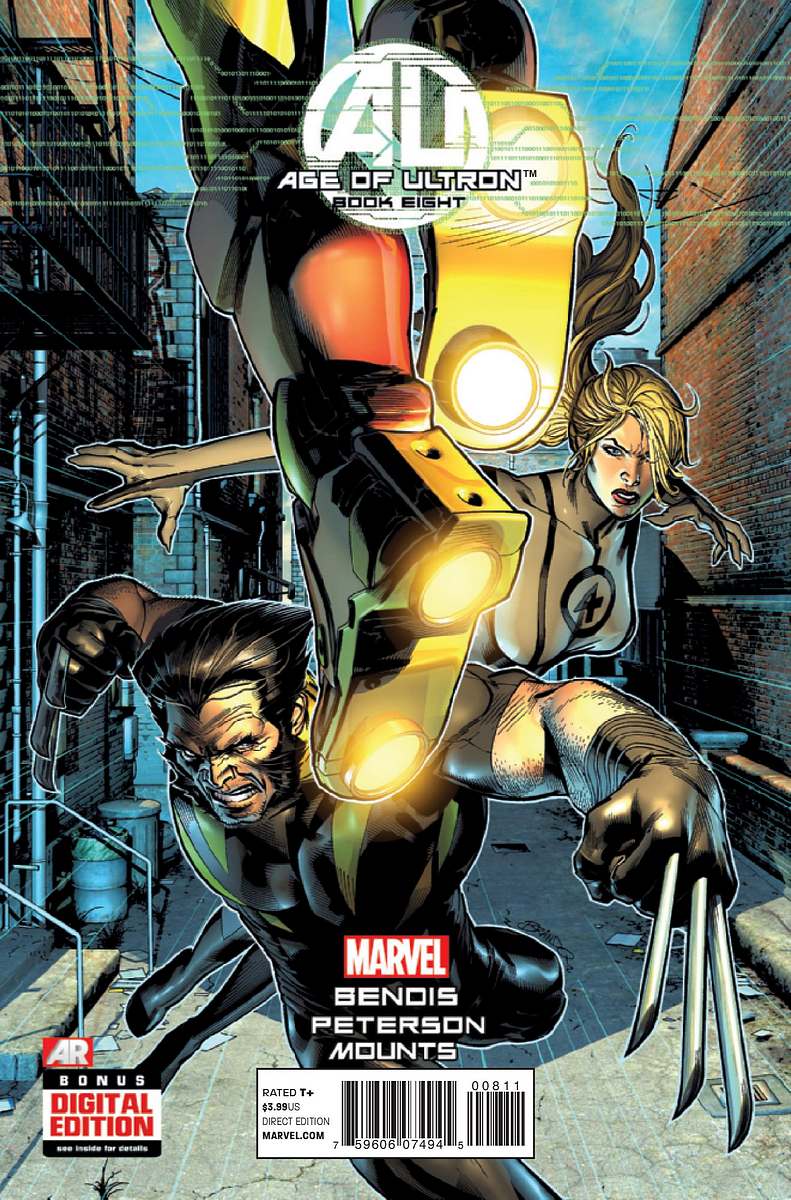
I think everything I've said about this series remains true as I remain annoyed at the length, annoyed at the need to drill the butterfly effect into readers, annoyed at the implication that Hank Pym is the cog that makes the Marvel Universe turn, annoyed at the writing style, and annoyed at spending so much time in an alternate timeline that we all know will not stick around. That said, I'd like to mention something I don't think I've really brought up that much in the run of this series: the art. I think the art is fine on more or less static images and situations, with people talking and the like. However, from the get-go (and even with different artists at the helm) I've found the action sequences to be overly chaotic and a bit hard to piece together. In most of the fights, there are so many colors and lines converging that it's hard to tell who's fighting from panel to panel and almost impossible to say who's winning. In the beginning, that was a little more excusable because the fights weren't really the focus; the state of the city was the focus. Now, though, the fights are very much at the center of a lot of these panels and don't really stand out as much as you'd like, especially to try to cover for the story or the excessive dialogue. I have a theory that says that you'll be able to read maybe four of these issues when all is said and done and have as much of an understanding of the story as someone who read all ten. We'll see if that's accurate as the last two issues come out.
Avengers: The Enemy Within 1
DeConnick (w) and Hepburn (a) and Bellaire (c)

The issue starts in pretty standard Captain Marvel form, which isn't at all a bad thing. There's a conversation between Captain Marvel and Spider-Woman that focuses around whether or not Rose is missing or just an old lady before chaos breaks out in the form of old-school villains the Grapplers. From there, the action never stops and the chaos piles up on Carol, who has trouble with her brain lesion (not helped by the fact that she insists on flying at one point) and with the whole situation. She suspects it's all a distraction to keep her from Rose before she realizes that Rose is the distraction. It's non-stop action but not in a way that feels forced or like action-for-action's-sake. It serves to keep Carol off-balance and unable to get a foothold on the situation, just as the audience is unsure of the villain's plot even though we know more than Carol (as Captain Marvel readers know it's Yon-Rogg behind everything and we watch him break into Carol's apartment while she's in Central Park). It's a really great layout and it feels already like this event is going to be something different and great, if incredibly stressful for fans who love Carol. I listened to an interview with DeConnick (found here) that features her at one point saying that she didn't plan too far ahead on these books because she didn't expect either of them to last. She cites people like Fraction and Bendis, who can plan series in year-long chunks, and Hickman, who can plan a series over a four-year chunk (amazing, and my fun fact of the day). She could have fooled me as this event seems born perfectly out of what she's done with both of her Marvel books over the course of the last few months. Looking forward to this one. It's also important to note that Scott Hepburn's art is solid throughout (and his characterization of Jessica particularly as someone who can't stop gesticulating) and Jordie Bellaire's colors are great and she uses the same color palette as on Captain Marvel, so the book feels like it slots perfectly into place.
Iron Man 10
Gillen (w) and Eaglesham (a) and Guru eFX (c)
 One of the reasons I've enjoyed Remender's Captain America series is that it's taken the Captain America history and said "what don't we know?" It turned out that the answer was "what was Steve like before he was old enough to even try to enlist in the army?" With that, Remender had a whole new level to add to Steve's character and a series all ready to write itself. Gillen has apparently done the same thing with Tony Stark, except we already knew more about Iron Man's childhood. It was his birth that we hadn't really examined before. 451 has shown the film to Tony and goes on to explain that Howard was scouring the Earth to find a way to save the unborn Tony's life. Doctors said it couldn't be done and that, in fact, if it was done, they'd have wished it wasn't, so damaged was Tony. However, that wasn't a good enough answer for Howard and, eventually, he found out about 451. At the time, 451 was being held by the Greys, a race of aliens (in the style of the stereotypical sci-fi alien) who had opened a casino in Vegas. They had stumbled upon 451 and captured him, knowing that he was valuable but unable to crack into any of that value. 451 awoke to one of the underlings of the Greys, Rollo, and appealed to him to break him out, offering a nice reward. Rollo meets with Howard and entices him, letting him know about 451's extensive knowledge, which Howard hopes can be parlayed into saving Tony's life. He assembles a team including the likes of Jimmy Woo, Thunderbolt Ross, and Dum Dum Dugan to name a few and we get a nice, old-fashioned heist comic. The heist is successful (though Rollo is found out and killed) and Howard and 451 apparently escape. Tony doesn't believe any of it and is put to sleep by 451, as they'll need him "before [they] reach [their] destination."
It's an interesting idea and, as I said, gives a nice little look into the parts of Tony that we don't know so well. I'm pretty well-versed in Marvel but I wouldn't ever claim to know every single character and every issue they've appeared in, so I can't guarantee it's never been mentioned that Tony wasn't projected to survive birth, but that does seem like a pretty big fact for me not to have found out, so I'm going to credit it to Gillen. It adds a layer to Tony's story which is then doubly added upon by revealing that he wouldn't have lived without alien tech and methods (which we have yet to really hear about). Was Tony more than just a regular child, albeit a little more intelligent and with more resources? We also can't ever rule out the fact that 451 is simply lying. Everything is a possibility and we've already seen 451 lie to get his way before. Occam's Razor would dictate that 451 lying is a far more simple solution than "Tony was going to die in childbirth so Howard tracked down a mysterious robot who had accumulated masses of knowledge and broke that robot out of an alien casino so that he could try to help save Howard's son." Then again, this is comics and that second argument is far more in line with how Wikipedia explains comic plots. Stay tuned to this one; whatever the answer and motivations behind 451, they're bound to be interesting and to put Tony in previously unexplored areas, both physically and emotionally.
Subscribe to:
Posts (Atom)