Showing posts with label bendis. Show all posts

Thursday, June 19, 2014

Uncanny X-Men 22, X-Men 15

Uncanny X-Men 22
Bendis (w) and Bachalo (p) and Townsend, Deering, Irwin, Mendoza, Vey, and Olazaba (i) and Bachalo and Villarrubia (c) and Caramagna (l)

The helicarrier continues to attack the X-Mansion while Hank brings Scott to the perpetrator and Magneto shows up with the drained Dazzler in tow. While Triage helps Dazzler, Hijack reappears, hoping to join up with the Jean Grey School, and manages to take control of the helicarriers again. Beast reveals to Cyclops that the person behind all of this is, in fact, Dark Beast, from the Age of Apocalypse timeline. Cyclops kind of inadvertently kills him when he blasts open his big suit that DB claimed was keeping him alive. Cyclops and Maria Hill have an argument on the front lawn and SHIELD and the X-Men's relationship gets a little rockier.

Things have ramped up quickly in the SHIELD Sentinels' attack on the X-Men as suddenly everything is converging on the Jean Grey School, just as Hijack deus ex machinas his way over to the campus. Overall, the action is pretty solid and the book reads a little faster for it though it's hard not to feel like simply too much happened. Between the attack and Magneto+Dazzler and SHIELD and Dark Beast, it feels like there was zero chance for the story to have meaningful impact because we're jumping too quickly from one thing to another. How can you worry about the implications of Dark Beast's actions when you're busy thinking about how SHIELD let this happen? How can you question the limits of Hijack's powers when you're busy trying to remember if there was some dumb subplot about Maria Hill being attracted to Cyclops in just another example of Hill's character being weakened by Bendis? How can you wonder about what Dazzler's going to do next when you're thinking about how terrible Maria Hill is? Too much happening, though it doesn't necessarily make the book unreadable, just smaller than it feels it should be.

Total Score: 3/5


X-Men 15
Wood (w) and Buffagni (a) and Mounts (c) and Caramagna (l)

The Future, who has trained for everything and who will, according to Kymera, manage to separate Jubilee and Shogo, is taken aback momentarily by the fact that someone in the X-Mansion killed one of his men. It doesn't line up with what he believes about the X-Men and it gives him pause about how to proceed, recognizing that there's at least one wild card out there. However, it doesn't give him much pause as he manages to take out Psylocke on the front lawn and proceed inside, where he finds Jubilee and shoots at her, grazing her head with the bullet and knocking her out to take her, though he doesn't quite take Shogo. MEANWHILE, the BROMO-SUPERIOR Wood/Briones mini-story wraps up as Psylocke saves her students by killing her danger room boyfriend (weird) in a big teaching moment.

The Future, though something of an inexplicable villain right now, becomes a little more interesting as he gets a bit of narration in this one. We don't necessarily get anything of his motive or his personality, but we start to see just how dangerous he is. He continues the theme that Arkea started, the idea that knowledge is real power and that his knowledge of a situation makes him a far more impressive villain than simply being a strong combatant. Wood also does a good job to settle out some of the team issues by having Ororo show a little more strength here, coming back to a place where the others respect her more. There's also a really nice moment in this issue where Jubilee, talking to Beast while he tries, perhaps ill-advisedly, to save Teon and Sprite with a bit of Arkea, boosts Beast up by talking about how much of a rock he is and how she knows he'll always be there to protect him. PERHAPS some ominous foreshadowing but, in the here and now, it's a nice win for Beast as a guy who hasn't had a lot of those recently.

Total Score: 4/5

Thursday, May 15, 2014

All-New X-Men 27, X-Force 5

All-New X-Men 27
Bendis (w) and Immonen (p) and Von Grawbadger (i) and Gracia (c) and Petit (l)

The Evil X-Men Brotherhood (the ones from the future who messed with everything in BATTLE OF THE ATOM and who need a better distinguishing name) have found the Xavier School and begun to attack, with Raze, the shapeshifting son of Mystique and Wolverine (it would seem), posing as a wounded X-23 and stabbing the healer first. Things get crazier as future Jean Grey and Charles, the psychic son of Mystique (posing, at the time, as Moira MacTaggert) and Xavier, launch a psychic attack on everyone at the school, even taking control of one of the Cuckoos to keep their power up. Only past Jean Grey, Emma Frost, and Cyclops remain hidden from the attack. When the evil brotherhood starts to get a location on young Jean, Emma knocks her out to keep them all protected, though it sends Jean into a state where Charles can talk to and threaten her.

Story
I'm doing everything I can to see this as a new story, something removed from BATTLE OF THE ATOM which I so loathed. It is extremely difficult to do that, though, as everything still seems to be linked to BOTA because that's the only time these characters have appeared. As such, the story right now is limited and we can only assume this group is here because they didn't like the way things turned out in the aftermath of BOTA and seek to rectify it (or to send the ANXM back to the past. There's more history given for Charles and Raze though not really enough yet to explain why they're both so mad, though that's surely coming. This issue then is dedicated mostly to the siege on the Xavier School and kind of makes you think "hey, maybe these kids aren't getting enough training in?" Okay, maybe that's not fair, they're facing two Mystique-mothered children with Wolverine and Xavier all mixed in there and another Jean Grey, on top of some others. Still, we'll have to wait a little longer before we can get a full sense of this story. 4/5

Character
The biggest character moments are for the enemies, as we do see a bit of flashback history for Charles and Raze. There's a bit here and there for other characters through the dialogue, but they seem to be our focus right now. Cyclops' team's healer, Christopher Muse (I had to look his name up because I do not have any sort of connection to these kids), gets a teeny bit of characterization and story as he freaks out over dying (understandable) and as we learn that he can heal himself, even if it's unconsciously. Still, not really an issue for characterization of our main team but it's kind of weird to me that this book has shifted so much into being a book about both the O5 team and Cyclops' team when it had originally been the O5 team and where Cyclops' team already has a book. 3/5

Writing
Still a bit of back-and-forth dialogue which, as ever, feels incredibly out of place in big and tense fight scenes. There are times to let off the gas with dialogue and a big fight scene always seems like one of them. There's also opportunity to keep everyone suspicious and paranoid and tense and Bendis touches on it a bit but I think the jokes and the quips kind of get in the way of that tone really establishing, which is a shame because the fight, for however forced it kinda feels, is still an interesting one as it develops (it's hard not to view the convenience of a team that has two sons of Mystique, one with Wolverine DNA and one with Xavier DNA, fairly cynically but that doesn't mean the fight still can't be interesting). 3/5

Art
I always like Stuart Immonen's art and I've come to really appreciate Marte Gracia's colors. I think the art really helps the book in a lot of ways and kind of draws the eye away from any problems in the story. 5/5

Miscellaneous
I don't know if you guys could tell but I'm having a lot of trouble separating this from BOTA.

Total Score: 3/5


X-Force 5
Spurrier (w) and J. Molina (a+c) and Sabino (l)

X-Force is prepped for an attack on Volga after getting all the information they could out of the dead Aggasiz. It turns out Aggasiz, a mutant who could travel through other dimensions, had worked for Volga stealing all sorts of weapons-tech from other universes in exchange for his kidnapped family's safety. The most problematic tech he stole was a sort of enhanced super soldier serum, which gave people incredible powers but also faded after a certain amount of time, killing the soldiers who used it. For Volga, that's not so much a problem, as he realizes country's will still use the serum and just come back for more when their batch dies (because he's truly horrible). This is, it seems, also what happened to Marrow (though she, clearly, didn't die) and, as she attacks Volga's compound, she wonders why she remembers so little of her experience. However, as her narrative rattles on and she continues referencing whoever she's talking to as "baby," it dons on her that she was pregnant before Alexandria and that they killed her baby. Psylocke manages to figure out what's happening right as it happens and makes sure Fantomex and Cable are covered as Marrow lashes out, wrecking through Volga's troops. Volga himself finally comes out and talks to Marrow, revealing that she knew the risks going in but that she volunteered in the hopes of getting her powers back. With Marrow out of the fight (now paralyzed with countless emotions) Volga's men knock out Psylocke and Fantomex and take all three with them as Volga reveals that they injected Cable with the soldier serum at Alexandria too and wonders why he hasn't died yet. It's not so big a problem, though, since he has a way to expedite the process and affixes it to Cable before tossing him off his HQ, allowing him to explode below while Volga ends up with the three other mutants.

Story
Good god, there's a lot happening here. Spurrier's a master at seeding little bits here and there throughout an arc and then watching it all hit home in one big reveal. It's Marrow's turn for narrative again this time and we get to see the pieces all start unraveling as her narrative leads us right to the fight and X-Force's loss. There's so much happening as we learn about how Marrow and Cable have powers again and we learn a good deal more about Volga (who is, by his own admission, a "comedy Russian bad guy") and the story of our team propels to an entirely new place. It's a pretty dark book and it's a pretty deep story and it's rather a thrill to watch it all come together (or come apart, as the case may be). 5/5

Character
Plenty is explained about a couple of our characters, which would be probably enough to boost this character score up by itself, but X-FORCE goes further than that. Each of these guys have such a distinct personality and we get a chance to see them all in their distinct roles, as Cable commands and leads, Marrow fights until the shocking news and then fights even harder and then shuts down, and Psylocke does what she can to keep everything moving the right way. The team knew about Marrow's baby and knew that the memories hadn't been removed from her, she'd repressed them because she couldn't deal with them. Psylocke tries to calm Marrow down when she learns and then tries to keep Volga from revealing the full truth to Marrow because she knows the impact it will have. Lots happening with every character, even with the noticeably quieter Fantomex, who continues reeling from last issue's crushing defeat wherein he started to see that maybe he wasn't the best there ever was at everything. Here he stays quieter, claiming to have a headache, and finds himself even more miffed as his bullets fail to kill the soldiers. Volga gets tons of characterization and it's totally over the top but he recognizes how over the top it is so Spurrier gets his chance to combat that accusation before it can land. Solid stuff all around, just an incredible book and we're only five issues in. 5/5

Writing
I have to think that all the writing I've done on this post already has told enough about the writing of this issue. I'll just mention that the pacing is really great, starting a little slower as they wait to attack, then instantly getting into it but in the same sort of balanced way that traditional superhero fights go until the revelation about Marrow's baby, which brings everything to a halt before really escalating the pace and, again, dropping it when Volga makes his big reveal. Between that and the wonderful Marrow narrative, Spurrier's got us right in his pocket. 5/5

Art
Jorge Molina steps in to do the art on this one and I think the change works pretty well, though I've liked Rock-He Kim's art (which is, I think, probably exactly what I said last issue, which also featured Molina on art). His Marrow is a little softer, even prettier, so that when she bones out (there's got to be a better description than that for her power) it's more abrupt and more fearsome. It's particularly effective in this issue when she also withdraws back into herself and we can see how small and devastated she is. Really strong stuff. 5/5

Miscellaneous
Geez, what a book.

Total Score: 5/5

Friday, November 15, 2013

All-New X-Men 18, Marvel Knights X-Men 1, X-Men Gold 1

All-New X-Men 18
Bendis (w) and Immonen and von Grawbadger (a) and Gracia (c)


BATTLE OF THE ATOM has finally wrapped and the dust settles to find Kitty inexplicably bringing the original X-Men to Cyclops' camp. The team officially moves in and meets their new teammates, some of whom are already at odds with them (at least one Stepford Cuckoo truly dislikes Jean), all while trying to deal with their own problems, most notably the love triangle of Hank, Scott, and Jean. Kitty's still teaching them, they have some new teachers in Cyclops and his gang, and there's drama within the ranks. Oh, and they got new uniforms.

Don't get me wrong, I'm extremely happy that BATTLE OF THE ATOM is over but I still have reservations about Kitty moving the original X-Men to Cyclops' camp, one that she has pretty adamantly refused to take part in and who she, up to now, has by and large been against. I also thought it was pretty weakly defined why she felt she needed to bring them there at all. She's reacting to the fact that the team she's been with for so long didn't trust her to make the best decision for the kids (??) and so she's decided to uproot and move to the militant X-team, despite her previous very outspoken qualms about the X-Men becoming something more militant. As if these two teams were the only two options. ALSO, if this is how things are going to play, why do we have ANXM and UNCANNY X-MEN? Won't they be focused on the same team, now? Argh.

Marvel Knights X-Men 1
Revel (w and a) and Peter (c)

The Marvel Knights line continues with a brand new X-Men book brought to us by Brahm Revel, who brings a noticeably darker tone to this corner of the world. In the first issue, Wolverine, Rogue, and Kitty head out from the Jean Grey School upon reports that kids (noticeably mutants but seemingly a bunch in general) are going missing in a small town in Virginia. Rachel Summers was inadvertently contacted by one of these mutants reaching out for help and now the small X-team is heading out that way to investigate. They manage to find a girl who seems to have pre-cog/persuasion powers and who is running out of a party after stealing drugs from a guy in that party. She flees the X-Men at first but eventually reluctantly joins up with them as they swear she'll be protected. Pretty sure there's something sketchy with her, you guys. Anyway, the gang comes to a seemingly abandoned house giving off a reading of a mutant inside. Wolverine goes through the front to investigate, sending Rogue to the back, and finds himself abruptly confronted by Sabretooth, who I'm actually getting a little sick of.

I like this book at its onset, even if I'm not a hundred percent sure of the story yet. It's already an interesting look at the characters and a darker look into this corner, something we haven't had for a little while now. Most of the books in the X-Men line right now are going for something more of a light-hearted feel, despite the tension of the situation mutants are in right now. Bendis certainly brings a more banter-filled air to the book while Jason Aaron tends to be more light in his approach to a lot of these stories as well. Brian Wood is a bit different but X-MEN hasn't really had a chance to show much of anything yet and ULTIMATE X-MEN (which I just found out today is apparently OVER, most depressingly) doesn't really count as this part of the universe (I mostly mentioned it so I could express sadness at it being over). Revel brings a darker and more mysterious story to the forefront here and his art emphasizes that. The art here is nice, a little more fluid than other X-books at the moment, with darker and more ominous colors from Christiane Peter to really sell the mystery. It's not quite like the art of MARVEL KNIGHTS SPIDER-MAN, which is going for a more experimental tone; this is still very much a comic layout but the appearance of the art looks more in line with indie books than with Marvel books. Very nice though, good opening piece. Still a bit sick of Sabretooth and unsure where this fits, as Kitty is still with the Jean Grey School and, again, is the first to express disdain at Cyclops' branch. Maybe Revel and Bendis should have had a talk.

X-Men Gold 1
Chris Claremont, Stan Lee, Len Wein, Louise Simonson, Roy Thomas, and Fabian Nicieza (w) and Bob McLeod, Walt Simonson, Bob Wiacek, Pat Oliffe, Jorge Molina, and Salvador Larroca (a) and Israel Silva, Andres Mossa, Chris Sotomayor, and David Ocampo (c)

As you might have guessed from that laundry list of legends up there, this is a 50th anniversary X-Men book featuring new stories from in-between-the-lines of old X-Men stories. The legends listed above each wrote a story set to take place between different moments of X-Men history, meant to slot nicely between the plots. It's a nice little compilation and one I can't add too much to, frankly. If you're a big X-Fan, you'll likely be best served checking out this book, even if it's not anything to really add to continuity or character or anything like that. It's a nice idea and a solid piece of X-history to boot. Fun bits here and there and old X-fans will certainly recognize the tones of each writer as not really having changed over time so it'll feel like they didn't miss a thing. Neat little book.

Thursday, October 24, 2013

Venom 42, Ultimate Spider-Man 28

Venom 42
Bunn (w) and Coelho (a) and Loughridge (c)

The final issue of Venom ends as Venom and Mania summon Mephisto to discuss the Devil's Mark that has apparently passed from Venom to Mania. Mephisto reveals that the symbiote appears to have cloned itself and pushed the Mark out with the clone, the crafty guy. Mephisto still will not remove the Mark, meaning that Mania is now the possible successor to Mephisto, as the Mark was attached to the symbiote, not to Flash. Flash, feeling fatherly, attacks Mephisto on behalf of Andi, though it has no effect on the devil. Mephisto waves if off, allowing Flash to live and act as a guardian for his possible successor, keeping her safe until her number is called. They, along with a little help from Mephisto, fight back Crossbones and his team, and end the current threat. Mephisto withdraws and Flash promises Andi he'll find a way to get the Mark off of her, to save her.

It's a nice final issue for Flash and it highlights a lot of the themes he's gone up against throughout the run on this book. Obviously his father was a really big theme and it kind of comes full circle here as he takes on a father's role for Andi (who just lost her father in the midst of all of this) and dedicates himself to her protection. It's also an introspective and retrospective time for Flash, who remembers all of his dreams throughout his life, becoming an all-star, a hero, a soldier, and realizing that, through all the hardships and all of the setbacks, he's really been able to do it all. Whether it's all he wanted it to be or not is still up for debate but there's no denying that his life has had some aura of greater purpose to it. It's a nice last issue with more impressive art by Coelho and really nice colors by Lee Loughridge (one of the times it stuck out to me was just flipping through the issue to get to the last page to remember exactly what had been said there and kind of zoned out as I flipped, just watching the colors go by, very stark, very different, very defined, great colors). Sad to see this book go, definitely one of the good, longer-running books. Surprised it lasted this long and certainly happy it was able to.

Ultimate Spider-Man 28
Bendis (w) and Marquez (a) and Ponsor (c)

Spider-Man, Spider-Woman, Bombshell, Cloak, and Dagger make their strike against Roxxon with fairly sound success. Mr. Roxxon himself is every bit the jerk you'd expect him to be and the kids act accordingly. He's not dumb, though, and he has his science team (all of whom, of course, have some level of power to themselves) come to his aid. He's also figured out Miles' true identity and flaunts the information over Miles as Miles, for several pages, keeps him dangling from the side of the building. There's a lot of info there, about the creation of this Spider-Man and Roxxon's place in the world and about Miles' family but it's not really stuff Miles is terribly interested in at the moment. The kids beat the science team and Jessica calls in SHIELD to clean up, though it's a little complicated because SHIELD has had contracts with Roxxon. As Monica Chang grills Jessica Drew, Jess reveals that she'd like to start up some sort of ongoing team with this group (hint number one that maybe Cataclysm won't, as advertised, destroy the Ultimate Universe).

Not a bad issue, which is certainly good considering where I tend to stand on certain Brian Michael Bendis books these days. There's still perhaps a little more back-and-forth jokey-joke dialogue for the feel the book wants. Actually, maybe that's part of the problem. It's hard to place what feel the book wants if you have these intense fight scenes as a result of this outrageous moral behavior but have people quipping and bickering playfully throughout. It's not always off-center as you have a bunch of teenagers working this case but it certainly doesn't help the flow of the book. Regardless, the story is pretty good and the art is phenomenal. Making the decision to have Roxxon dangle off the side of the building, webbed up by his feet, with Spider-Man sitting above him for a few pages works pretty well. We get a fair amount of information in a way that, while feeling kind of over-exposition-laden, makes sense because we see Roxxon panicking and freaking out a bit, no matter if it's out of fear or rage or parts of each. Keeping Miles silent through it all, only to end by saying "you're under arrest" after Roxxon explodes for a few pages, is another solid call, giving us a nice side of Miles and letting us watch Roxxon deteriorate. As I said, fine art helps carry the issue as well, making the fight scenes more entertaining and the exposition more interesting. Pretty good issue.

Friday, October 18, 2013

Superior Spider-Man 19, Fantastic Four 13, Guardians of the Galaxy 7

Superior Spider-Man 19
Slott (w) and Stegman and Livesay (a) and Delgado (c)


Spider-Man knocked out Spider-Man 2099 for some perceived slight and now finds himself at the center of an imploding space-time portal at Horizon Labs. He and Max Modell set the other scientists to work building a device that they hope can defeat the portal but it requires a formula Peter came up with his very first meeting with Max. Doc Ock can't remember it and zones out for a while trying, significantly reducing the amount of time he has to figure out how to stop things. Max evacuates the building, though Spider-Man stays in, as does the recovering Spider-Man 2099, who is holding Tiberius Stone. He's had a bit of a change of heart and seems ready to destroy Stone to destroy the future that revolves around Alchemax, even if it means destroying himself. At the last second, he recants and the two flee from the explosion. Spider-Man is able to contain it to just that area, saving the future and the present, but he disappears in the blast. Tyler Stone strands Spider-Man 2099 in the present, where he gets a job as Tiberius' personal assistant at the newly formed Alchemax. Modell and company manage to rig up a device to pull Spider-Man out of the time flux and save him, though Max sees it as the two of them evening up and leaves him behind as they set off to sea to do science in open waters. Meanwhile, Carlie Cooper and Wraith have tracked the money that Spider-Man used to hire his private army back to Otto Octavius.

Plenty of things changing for the Spider-Man universe as Spider-Man 2099 finds himself stuck in the present and guarding his own great-grandfather while ultimately trying to bring down his company. Doc, meanwhile, finds himself removed from Horizon Labs, though he's trying to recruit at least former co-worker Sajani, who was also left behind by Max. Last but not least (well not quite last either, MJ also distanced herself from Spider-Man), Carlie seems to recognize the link between the stranger and stranger actions of Spider-Man and Doc Ock's money. Still, the writing of this one is a little bogged down by the plot and the changes it needs to facilitate, making this one of the weaker issues for character and writing even though it's a significant event in this Spider-Man's run. This arc, seemingly coming to a close though the events it kicked off certainly are just starting, was not my favorite arc of the new run (far from it) but it seems to have done its job in changing the status quo a bit. I'll be interested to see where the book goes from here.

Fantastic Four 13
Fraction and Kesel (w) and Bagley and Rubinstein (a) and Mounts (c)


Slightly confusing issue as we see what exactly happened in Old John Storm's universe before he found himself in the 616. Like his 616 counterparts, the Fantastic Four of his universe left to explore the cosmos, with John accompanying his brother Stevenson Storm and Stevenson's wife Sue, as well as their friend Ben Grimm as the Fantastic Four (their powers are essentially the same). In their universe, Doom, Kang, and Annihilus have teamed up to take over the world but find themselves blocked by the F4. They've considered jumping universes but prefer, for now, to end the F4 and do what they need to rule this universe. Despite a solid plan by Stevenson and the FF, someone in the F4 seems to have betrayed them and forewarned Doom about an attack, which ended up making their powers useless against Doom and leaving them without any sort of way to protect themselves (which is how John lost his eye). It's at this point that John wakes up in the 616 again and finds our F4's powers rapidly deteriorating. However, the dream seems to have jarred something loose as suddenly he knows a way to fix their powers, though it will leave them, as he says, "doomed."

Alternate universe are and always will be tricky things to handle. When they're done well (like so much Jeff Parker's Dark Avengers run), they're entertaining and challenging, typically twisting characters we already know into something we don't know them as but which we can understand. In this case, we get a few changes that seem more than a little strange and a few non-changes that seem altogether entirely too coincidental to be ignored. They still choose the same successors to lead the FF in their absence, Doom has still killed Scott Lang's daughter, the same kids (majority) are still involved in the FF, the original X-Men are in the present again (though Jean Grey seems less obsessed with staying there), and so on. The conceit of a lot of these other universes is that tiny changes all over the universe have resulted in massive, sweeping changes as time went on. It's essentially the butterfly effect but in a parallel universe, or the idea of timeline-splitting. Here, it seems like little changes here and there have resulted in just very little change at all in the superhero community. Granted, this is a small window into that community so it's maybe best not to judge, but it's a strange decision, just as it's a strange decision to reveal this much to us. Sure we needed at some point to explain Old John Storm away but this seems like a lot we didn't necessarily need to see. I guess we'll see if that's the case moving forward.

Guardians of the Galaxy 7
Bendis (w) and Pichelli and Schiti (a) and Ponsor (c)

Angela's past is explained as she gives a brief history of her home, in her dimension. Her home is called Heven and it sounds more or less like the stories we know of Heaven, though with a darker and grittier twist of everyone there being hunters, essentially. As I've said before, I don't know Angela prior to this so all of this information is rather new to me. Like us hearing of Heaven, she's heard about Earth and she wants to see it for herself. She describes seeing what Starlord saw when the time-space continuum ruptured and he decides that she's telling the truth and that they should let her go. She moves to Earth with the understanding that Earth is full of super-people and that she shouldn't pick any fights there. She goes, with them following to make sure they didn't screw up in letting her go, and she's blown away by how much it matches the description she had. She's still lost and a bit confused in this universe and so Starlord gives her a comm so she can call to them if she needs help while she finds her way and she departs into the stars again while the Guardians discuss what else might have come through.

Not a bad issue as this continues to be, for my money, the best book Bendis is writing. I think the characters do tend to stray a little far into his generic personalities but he manages to reel them in well enough to keep them distinct. I heard an interview on the Nerdist Writer's Panel: Comic Edition podcast with one of the writers for the first Thor movie and, when asked what he's liking right now in comics he cited Bendis and said that he recognizes complaints that say Bendis loads books with a disproportionate text to story ratio but he thinks the dialogue is wonderful in building character. I still disagree on the whole as I think Bendis mostly writes the same personality or the same couple of personalities for every character. I've talked about this more than enough on here but I do think it diminishes character when you could read just about any dialogue block without looking at who it's attached to you would have about five guesses at who it could be. The best written characters are one where you can read the dialogue and you know who's talking, even if you don't see them. I think Guardians is Bendis' best book to try to do that with but, even in that, there are a couple of personalities; there's the Tony/Quill/kind of Rocket personality and there's the Gamora/Drax personality. Take out the names and pictures in this issue and it's a little hard to discern who's who but it definitely keeps itself closer here. Next issue claims to be about Infinity, which should kick off a tie-in just as Infinity begins wrapping up. Strange choice but a choice, I suppose, nonetheless.

Thursday, September 5, 2013

X-Men Battle of the Atom 1, All-New X-Men 16

X-Men Battle of the Atom 1
Bendis (w) and Cho w/ Immonen and von Grawbadger (a) and Gracia (c)

Eagle-eyed readers will notice that I've been a bit wary about events of late. I've tried to maintain that an event, by its nature, isn't a bad thing as long as there's a story worth telling. Marvel has worked for a long time to make a universe that is interconnected so it stands to reason that we should, occasionally, have stories that involve the entire universe. As long as they're good stories. Meanwhile, the future X-Men have shown up to tell the present X-Men to send the past X-Men back home or else we'll get a dystopian future that screams of both Age of Ultron and Days of Future Past. Let's start from the beginning. By which I mean with pages of recap of what's happening. Nevermind, let's not start with that, except to say that the first page shows Illyana jumping into the future to see what becomes of the X-Men (because traveling through time and space is only ripping apart the universe when it's convenient for a story. BENDIS, you wrote Age of Ultron, these are your rules) in a scene that is reminiscent to the opening scenes of Age of Ultron and many scenes in Days of Future Past. Things are going badly and she writes a letter to Scott Summers to sum up what he already knows and that's our lazy, lazy introduction. Anyway, Kitty and her team of All-New X-Men go to identify and either help or bring down a new mutant with dangerous powers in Arizona. Pretty quickly upon their arrival, a score of Sentinels attack followed by the appearance of Cyclops' team, presumably monitoring Sentinel activity. There's the usual Bendis banter and the two teams combined manage to bring down the Sentinels (suddenly, again when it's convenient, Kitty is happy to see Scott; not just in a "we could really use help" way, in a way that seems like "gee how we've all missed you!"). One Sentinel shoots young Scott, knocking him to the edge of death. Old Cyclops disappears until Triage, Cyclops' new mutant healer, saves Scott. Cyclops blips back into existence and everyone goes home. The present-day X-Men vote to send the past X-Men home (finally) when they're interrupted by the X-Men of the future appearing among them.

I feel like if someone were to write a parody of All-New X-Men, it would read a little like this. Actually, it would read almost entirely like this. "The future X-Men have shown up to tell the present X-Men to send the past X-Men back home" is a sentence I actually wrote up there and no one finds that ridiculous? I wasn't thrilled with the opening, loaded with exposition and summation, but I started to try to accept this book even as it started feeling like every other event it could get its hands on. When they voted to send the original X-Men home, I was like "duh, finally." (why it took someone almost dying to realize implications of time travel in a world that has had Back to the Future for over 25 years now is beyond me) Then the future X-Men showed up and I switched off again. Is there a way to make this event interesting and not hacky again? I don't know. Maybe. I sure don't know what it is though. And chapter two of the event, reviewed next, certainly doesn't help things (spoilers).

All-New X-Men 16
Bendis (w) and Immonen and von Grawbadger (a) and Gracia (c)

The future X-Men chat with the present X-Men about sending the past X-Men home (ug, had to write it again) and explain that not sending them home would be a giant mistake, wondering why they haven't done it already. The future X-Men team has older versions of Kitty, Beast, Iceman, Deadpool, and Runaway Molly Hayes, as well as a younger man claiming to be Xavier's grandson (named Xavier) and someone costumed as Xorn, former X-Men teammate and eventual betrayer and killer of Jean Grey. All the basic jokes come out ("I look like that in the future?") before young Jean panics, unable to read the newcomers' minds, and creates a situation wherein chaos ensues and she and young Scott run away. Back at the school, they all talk some more and Xorn reveals herself to be, in fact, Jean Grey, because of course she is. Everyone wonders why young Jean and Scott ran off and Xavier and Jean reveal that it's because they were guarding their thoughts, which makes Wolverine as suspicious as Jean had been. The reveal of Jean as Xorn, though, is where we leave off, seeing as well that young Jean and Scott have beached themselves somewhere removed after Jean reveals that she can't go home because she's afraid her new psychic powers will fight back against their Xavier if he tries to wipe their minds.

Imagine a Sherlock Holmes story where Sherlock leads the police from a recently murdered corpse through a house, following bloody footsteps, to a man holding a bloody knife and a gun (he used the knife, the gun is a clever red herring) talking to himself about the murder he just committed and, upon seeing this, the police yell "By Jove, Holmes, I don't know how but you've done it again!" That's what this kind of feels like. Everyone is suddenly incredibly stupid and we're supposed to accept this as a story because everyone is equally stupid so the tension is exactly the same as it would be if everyone was incredibly intelligent. Here, the biggest idiotic thing we're forced to accept as clever is Jean's panic over the fact that the future X-Men are guarding their minds. You might be able to pass it off as simply an excuse she used to run away before she was sent home but then even Wolverine, when he finds out the future X-Men are guarding their minds, says "Now why would you go and do a thing like that?" This is after nearly FIFTEEN ISSUES of people telling Jean that she shouldn't be reading other people's thoughts without their permission. People are constantly guarding their thoughts from psychics in the Marvel Universe because, if they didn't, there would be no ambiguity. So yes, there is ambiguity of people merely mention that thoughts are being blocked but to use it as a full-on plot device is so stupid. I would talk about more but there really isn't much more. There's one scene where the present X-Men talk to the future X-Men (making jokes and exposition) and then that scene is replayed as the backdrop to Jean trying to convince first Henry, who won't bite, to run away with her and then Scott, who instantly agrees. I BETTER GET NIGHTCRAWLER BACK OUT OF THIS STORY.

Friday, August 2, 2013

Uncanny X-Men 9, X-Men 3

Uncanny X-Men 9
Bendis (w) and Bachalo (a) and Townsend (c)

SHIELD agent Dazzler shows up at Fabio's home to try to talk to him about his new mutation and to get answers about Cyclops' new X-Men team. The atmosphere is not particularly welcoming and she ends up needing to stun Fabio and his family so he can remove Fabio from the situation. Meanwhile, Scott is trying to train his X-Men when the news report of Fabio's abduction hits them. Of course, SHIELD is pretty stupid, as is typical, and didn't think any of their actions through so the X-Men know where he's being held.

I've gone on and on before about the back-and-forth dialogue Bendis employs to make his books seem quick-paced and witty which, in my opinion, fail to do either of those things but rather make the book drag and make every character sound the same, which is to say less like an actual character. It hits home again here as he has a wacky, fun-filled scene at Fabio's house when Fabio's father pulls a gun on Dazzler. Yes, you read that all correctly. Fabio's father pulls a gun on Dazzler and threatens her and it's played off as part of the hilarity of the scene. Later, when SHIELD pulls Fabio in, it takes literally no effort for Scott's team to find him, which Coulson pieces together immediately after they bring the new mutant to them. Both of these things are examples of lazy writing. The people do whatever the plot dictates they do, no matter how inane and ridiculous, simply to move the book forward. The ending features Mystique because Bendis seemingly can't get enough of her and, as Bendis is wont to do, that means she's appearing everywhere he can put her (a la Hawkeye, Luke Cage, and Spider-Woman in his Avengers runs). I think part of the idea in the snappy writing here, if I'm being generous, is that the X-Men have always functioned as something of a family, people bonded together over a connection they didn't choose to have. However, it feels unlike any sort of family and more like a collection of of people who have never entered into a real conversation before in their lives and suddenly all they do is talk, with every character feeling the need to input at least fifty throwaway lines per conversation. So in short, I continue not to recommend this book.

X-Men 3
Wood (w) and Coipel and Morales (a) and L. Martin (c)

The team that left the school is closing in on Arkea back at the hospital she originally landed at, where she took over Jubilee's new son. Waiting for her there is a full wing of people with cybernetic neural implants, meaning that Arkea can take over any and all of them. That's what's waiting for Storm and company when they arrive. Meanwhile, back at the school, her bomb seems to have detonated, though not in an explosive way. Instead, it's done its own thing, hacking the systems at the school and creating, possibly, some Karima drones in the Danger Room. Can Kitty shut the Danger Room down in time? Will it matter if Storm and her team don't shut Arkea down? What will be left of Karima if they succeed?

There's a lot happening here for a three issue arc and it suffers in a respect. You don't want arcs to drag on too long or else they stagnate a bit. However, not giving enough time can make the whole thing feel rushed and poorly explained. That's how I came away feeling after this issue. Arkea certainly was a huge threat, the first and second issues showed that pretty well. In the final issue, though, she seems a whole lot less intimidating. She's sort of intimidating at the school but she's taking on Kitty and a handful of students and her most intimidating moment is when she shuts the oxygen off in a room they quickly break out of. If she's not involved in issue four (unknown, obviously) then this is a weird arc conclusion. Still, the team feels pretty good and they move in an appropriately coordinated way, leaving some faith for the coming series. Feels a bit early to give a judgment on this series, but I wasn't exactly blown away by its first storyline.

Thursday, June 6, 2013

Daredevil: End of Days 8, Daredevil Dark Nights 1

Daredevil: End of Days 8
Bendis and Mack (w) and Janson and Sienkiewicz w/ Mack (a) and Hollingsworth (c)

Books like this one make me feel like maybe I've lost touch with myself as a comic reader. Well, books like this one and Twitter. On Twitter, I follow both Brian Michael Bendis and David Mack and I love one of those men very much because I think he's an incredible talent who helped me realize just how much art can go into comics (the other one I nearly constantly sigh/yell at in my comic blog). David Mack particularly has been retweeting a lot of positive things about Daredevil: End of Days as a whole and the twist ending which surprised so many readers. So I had to ask myself "is this just because he tracked down the positive reviews/that only people who loved the book are taking the time to write to them about it or am I wrong about this series?" Of course, liking something is a rather objective definition whereas reviewing something should come from a neutral place and based on knowledge about what objectively makes something good or not. I know that by claiming this is a review blog, I'm kind of inherently saying I can do that but sometimes I'm not sure that's accurate. Maybe I've lost track of comics over the years and now I'm jaded and cynical. I just didn't care for this series. That's coming as someone who loves Daredevil and loves David Mack and, in the right circumstances, can appreciate an alternate reality-esque future. But I just didn't care for this series. I think, again, it kind of stems from the fact that this series was eight issues long. After issue three or four, I was annoyed by the mystery of Mapone more than I was curious about it. It kept coming up and it was clear it wasn't going to be answered in any quick way and the writing prodded the reader to keep asking "WHAT IS MAPONE," a question I was already sick of asking and I, in turn, begin to resent the fact that they wanted me to care. You know what it's like? It's like that scene in Wall-E where Eve asks Wall-E what his directive is and he shows her how good he is at compacting trash, then when he struggles through the word "directive?" she turns away from him and says "Classified." It's a great little moment in the film and would have been SO awful if he had kept asking her and she had kept saying "classified" but kept prodding him to ask anyway. Okay, maybe it's only like that if you're me.

Timothy, the little boy that Daredevil rescued once upon a time is the new Daredevil and we get a few scenes of the two of them as Matt trained him late in his life (in fact, just before he died). He explains that someone will appear to him to guide him when the time is right, just as Stick did for him, and that he'll know it when he sees it. Now, with Timothy's father Ben and his mentor Matt dead, he's desperate to find out who his "Stick" will be. He runs into people from Matt and his father's past, including Foggy Nelson, Punisher, Peter Parker, and Nick Fury, but none of them are his Stick. Fury offers him the secret of Mapone but Timothy, angry that Fury didn't give this information to Ben when he had the chance, throws the file in a trashcan fire. He returns into a bar he was visiting with Peter Parker (who attempted to help him work through his grief in a scene that can't help but have some SNAPPY DIALOGUE) to find that the red-headed woman playing pool with a bunch of hoodlums is in trouble as the hoodlums feel she's been conning them. Timothy jumps into the fight and takes out a couple of the guys before being critiqued by the woman for his fighting style. She then reveals that she's blind, the only thing her father left her, and that she can help train him to fight. Her name? Mapone Romanova, the daughter of Matt and Black Widow. If anywhere, this is where I'm jaded and cynical. The things I've read on Twitter make this seem like a huge and shocking reveal but is it? I mean, we saw Ben investigate all of Matt's former lovers and each one of them had a red-headed child. He couldn't track down Widow but should anyone be surprised she also had a child with Daredevil? Also, and I hate to be that guy, but Mapone is a stupid name.

Daredevil Dark Nights 1
Weeks (w and a) and Loughridge (c)

Daredevil Dark Nights is an eight part series that will feature three adventures for Daredevil written and illustrated by three different creative teams. Lee Weeks is heading up the first arc, a three issue story called "Angels Unaware," which focuses on Matt Murdock trying to deliver a heart to a little girl waiting in a hospital during a massive snowstorm. Matt fell asleep in the office reading the bible (getting back to Matt's Catholic roots) and wakes up to find the city effectively shut down. He decides to walk home, as his office is just a short walk, but the snow messes with his radar sense a bit. When a few muggers accost him on the empty streets, he makes quick work of a pair of them but doesn't sense the third one behind him, who knocks him unconscious and steals his money, leaving his wallet out, to be covered by the snow. A man (possibly homeless?) carries the unconscious Matt to the nearby hospital where he wakes unsure of who he is and startled to find that he's blind and everyone appears to be screaming (he doesn't remember his senses). Eventually things come back to him as he rouses himself and incapacitates the three muggers, who have turned up in the hospital lobby to ransom the people there. His doctor returns Matt to his bed and asks who he is. He asks her about the little girl who needs a heart transplant and is waiting for the helicopter that is trying to brave the snow to bring it to her. He informs the doctor that he heard the helicopter go down (the city is just about silent in the snowstorm so he could isolate the helicopter pretty easily) and that he can go get the heart. The homeless man had brought a suitcase that had been with Matt to the hospital and a member of the hospital staff had been trying to open it in the hopes it would reveal his identity (with his wallet buried in the snow). He gets it open and reveals to the doctor that the man is Daredevil. She brings him to the roof so he can try to retrieve the heart and hopefully save the little girl. He stumbles a bit in the snow as he dives off the roof so this may not be as easy as it could be for Daredevil.

This is definitely an interesting spin on Daredevil. It's very religion-laden, which could turn some readers off. That's always been a kind of interesting facet to Matt's character for me, even if it occasionally gets ignored or gets heavy-handed. Here I'd say it's more heavy-handed than maybe it needs to be, but it certainly illustrates the themes of this arc and the fact that Matt is religious. If you were picking up this Daredevil book and the only things you'd read had come from the last few years of Daredevil, you'd likely be startled to find him so engrossed in the bible and holding a chain with a cross on it. Still, it's not out of character, just a little different than what we've seen. The story is already engaging and the art varies between good and great at times. Weeks' three issues should be a good read on Daredevil's character and give us some thing to talk about before David Lapham takes over writer and artist duties for the two part "What a Day, What a Night" and Jimmy Palmiotti and Thony Silas give us the three issue arc "The Trip" to end the series.

Wednesday, May 15, 2013

Age of Ultron 8, Avengers: The Enemy Within 1, Iron Man 10

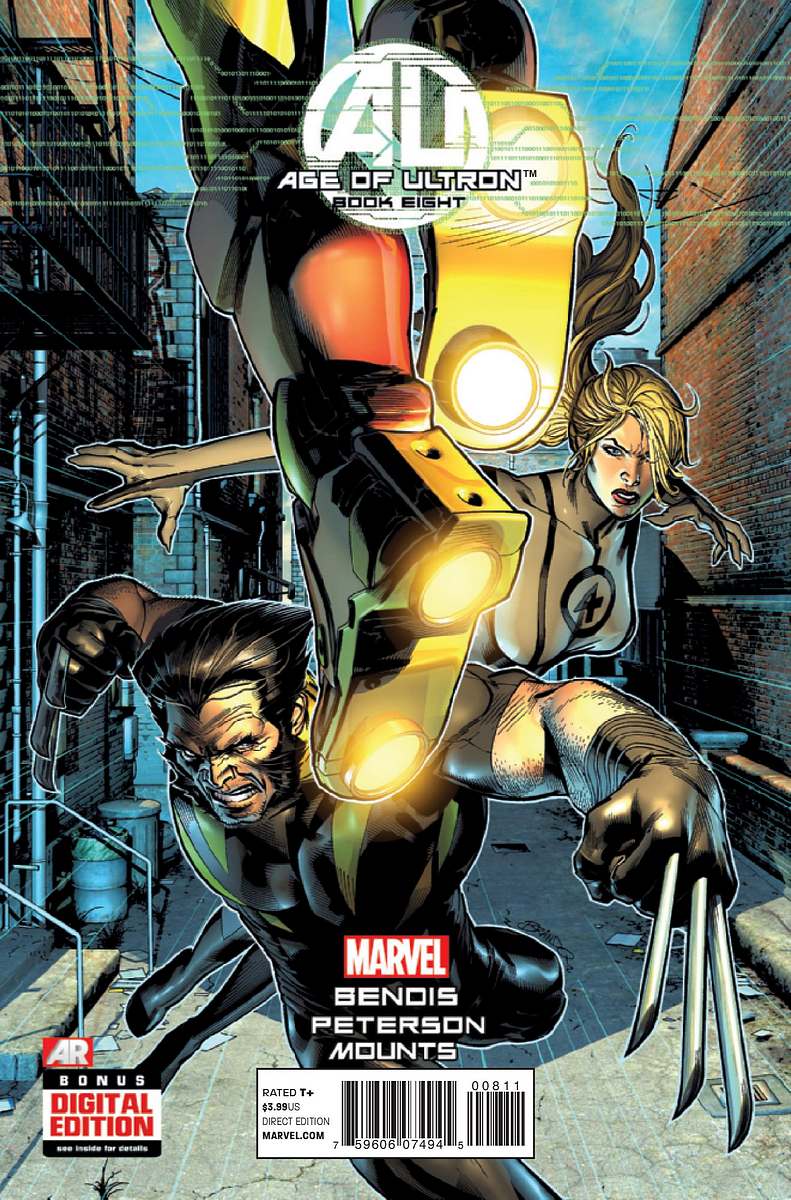
Age of Ultron 8
Bendis (w) and Peterson (a) and Mounts (c)

So we learn a little more about this alternate timeline as Bendis again tries to make us learn about the butterfly effect. The Tony Stark of this world questions Wolverine after accessing both Sue and Wolverine's memories alongside Professor X and Emma Frost. He learns that Wolverine was responsible for killing Pym and setting the world on a different timeline before explaining to Wolverine that the timeline he's created led to a war between technology and magic that caused Asgard to abandon Earth and divided the world into pretty much Tony's half and Morgana le Fey's half. Stark is ever suspicious of an attack from le Fey and spends some time believing that Sue and Wolverine are constructs of hers, an idea that is reinforced when le Fey attacks at a particularly inopportune time for our heroes. Meanwhile, the Defenders don't like Tony and want to talk to the prisoners. Then le Fey shows up and splits Tony's helicarrier in half.

I think everything I've said about this series remains true as I remain annoyed at the length, annoyed at the need to drill the butterfly effect into readers, annoyed at the implication that Hank Pym is the cog that makes the Marvel Universe turn, annoyed at the writing style, and annoyed at spending so much time in an alternate timeline that we all know will not stick around. That said, I'd like to mention something I don't think I've really brought up that much in the run of this series: the art. I think the art is fine on more or less static images and situations, with people talking and the like. However, from the get-go (and even with different artists at the helm) I've found the action sequences to be overly chaotic and a bit hard to piece together. In most of the fights, there are so many colors and lines converging that it's hard to tell who's fighting from panel to panel and almost impossible to say who's winning. In the beginning, that was a little more excusable because the fights weren't really the focus; the state of the city was the focus. Now, though, the fights are very much at the center of a lot of these panels and don't really stand out as much as you'd like, especially to try to cover for the story or the excessive dialogue. I have a theory that says that you'll be able to read maybe four of these issues when all is said and done and have as much of an understanding of the story as someone who read all ten. We'll see if that's accurate as the last two issues come out.

Avengers: The Enemy Within 1
DeConnick (w) and Hepburn (a) and Bellaire (c)

One of the reasons that I've really liked DeConnick's run on Captain Marvel is that she's made it a point to, throughout the series, establish that Carol has a life outside of the Avengers. It's maybe not a huge part of her life in terms of time-spent, but it's clearly massive in terms of how she identifies herself. She doesn't live at Avengers Mansion, she stays in an apartment. She has a routine that involves getting coffee or croissants at the same place and meeting up with an elderly lady each day. At her apartment, she has people that she cares about including the little girl who wants to be her and that girl's mother. She has Tracy the surly older woman with whom she bonded over their sicknesses. She had Helen Cobb (albeit in time displacement). She has Avengers friends too, like Spider-Woman and Captain America and Tony Stark, but she has more social visits from Avengers than you see in most solo books. The creation of Carol's little universe unto herself and the importance of it in her daily life is already playing a huge role in this series, as Rose has been kidnapped by Yon-Rogg (Carol does not know it's Yon-Rogg behind everything, but we've already seen him) and hidden away. With the help of Spider-Woman and Thor, Carol is able to track down Rose but finds that Rose has been a diversion so her captor could break into Carol's apartment. Carol hurries back to her building and clears everyone out of it. She busts into her own room (scaring her cat Chewie) and finds that her enemy has broken into her footlocker of important items. Missing from the footlocker is her piece of the psyche-magnetron, the machine that gave her powers and that is, as she describes it, essentially a Kree-built wish-machine. Now the world is in danger and she feels it's her fault. Spider-Woman rallies around her and insists that now the Avengers are involved and this guy will not get away with this.

The issue starts in pretty standard Captain Marvel form, which isn't at all a bad thing. There's a conversation between Captain Marvel and Spider-Woman that focuses around whether or not Rose is missing or just an old lady before chaos breaks out in the form of old-school villains the Grapplers. From there, the action never stops and the chaos piles up on Carol, who has trouble with her brain lesion (not helped by the fact that she insists on flying at one point) and with the whole situation. She suspects it's all a distraction to keep her from Rose before she realizes that Rose is the distraction. It's non-stop action but not in a way that feels forced or like action-for-action's-sake. It serves to keep Carol off-balance and unable to get a foothold on the situation, just as the audience is unsure of the villain's plot even though we know more than Carol (as Captain Marvel readers know it's Yon-Rogg behind everything and we watch him break into Carol's apartment while she's in Central Park). It's a really great layout and it feels already like this event is going to be something different and great, if incredibly stressful for fans who love Carol. I listened to an interview with DeConnick (found here) that features her at one point saying that she didn't plan too far ahead on these books because she didn't expect either of them to last. She cites people like Fraction and Bendis, who can plan series in year-long chunks, and Hickman, who can plan a series over a four-year chunk (amazing, and my fun fact of the day). She could have fooled me as this event seems born perfectly out of what she's done with both of her Marvel books over the course of the last few months. Looking forward to this one. It's also important to note that Scott Hepburn's art is solid throughout (and his characterization of Jessica particularly as someone who can't stop gesticulating) and Jordie Bellaire's colors are great and she uses the same color palette as on Captain Marvel, so the book feels like it slots perfectly into place.

Iron Man 10
Gillen (w) and Eaglesham (a) and Guru eFX (c)

One of the reasons I've enjoyed Remender's Captain America series is that it's taken the Captain America history and said "what don't we know?" It turned out that the answer was "what was Steve like before he was old enough to even try to enlist in the army?" With that, Remender had a whole new level to add to Steve's character and a series all ready to write itself. Gillen has apparently done the same thing with Tony Stark, except we already knew more about Iron Man's childhood. It was his birth that we hadn't really examined before. 451 has shown the film to Tony and goes on to explain that Howard was scouring the Earth to find a way to save the unborn Tony's life. Doctors said it couldn't be done and that, in fact, if it was done, they'd have wished it wasn't, so damaged was Tony. However, that wasn't a good enough answer for Howard and, eventually, he found out about 451. At the time, 451 was being held by the Greys, a race of aliens (in the style of the stereotypical sci-fi alien) who had opened a casino in Vegas. They had stumbled upon 451 and captured him, knowing that he was valuable but unable to crack into any of that value. 451 awoke to one of the underlings of the Greys, Rollo, and appealed to him to break him out, offering a nice reward. Rollo meets with Howard and entices him, letting him know about 451's extensive knowledge, which Howard hopes can be parlayed into saving Tony's life. He assembles a team including the likes of Jimmy Woo, Thunderbolt Ross, and Dum Dum Dugan to name a few and we get a nice, old-fashioned heist comic. The heist is successful (though Rollo is found out and killed) and Howard and 451 apparently escape. Tony doesn't believe any of it and is put to sleep by 451, as they'll need him "before [they] reach [their] destination."

It's an interesting idea and, as I said, gives a nice little look into the parts of Tony that we don't know so well. I'm pretty well-versed in Marvel but I wouldn't ever claim to know every single character and every issue they've appeared in, so I can't guarantee it's never been mentioned that Tony wasn't projected to survive birth, but that does seem like a pretty big fact for me not to have found out, so I'm going to credit it to Gillen. It adds a layer to Tony's story which is then doubly added upon by revealing that he wouldn't have lived without alien tech and methods (which we have yet to really hear about). Was Tony more than just a regular child, albeit a little more intelligent and with more resources? We also can't ever rule out the fact that 451 is simply lying. Everything is a possibility and we've already seen 451 lie to get his way before. Occam's Razor would dictate that 451 lying is a far more simple solution than "Tony was going to die in childbirth so Howard tracked down a mysterious robot who had accumulated masses of knowledge and broke that robot out of an alien casino so that he could try to help save Howard's son." Then again, this is comics and that second argument is far more in line with how Wikipedia explains comic plots. Stay tuned to this one; whatever the answer and motivations behind 451, they're bound to be interesting and to put Tony in previously unexplored areas, both physically and emotionally.

Friday, April 26, 2013

Guardians of the Galaxy 2, Journey into Mystery 651, Fury MAX 11

Guardians of the Galaxy 2
Bendis (w) and McNiven, Pichelli, Dell, and Morales (a) and Ponsor (c)

The Guardians go into London to stop the Badoon attack. The Badoon have cut off all types of communication to and from the city, leaving the Guardians as the only ones available to fend off the invasion (aside from possibly Captain Britain, but Iron Man waves off the suggestion inexplicably). The team splits up and each hero, aside from Groot who is still regrowing, takes a Badoon ship to take out. They do pretty well, with Rocket perhaps doing the best. He storms through a ship, killing off anyone in his way, before setting the ship to self-destruct and crash into another ship. Drax is on that ship and only barely, with the aid of Gamora and Iron Man, escapes the explosion. When they land, they ask if he's okay and he waves them off angrily. Meanwhile, the Spartax King (Quill's father) holds a meeting with the Kree Supreme Intelligence, Young Annihilus, Gladiator of the Shi'ar, the queen of the Brood, Freyja the all-mother of Asgardia, and Y'Gaaar of the Badoon in the Negative Zone, which apparently can just be opened and closed at will. They meet to discuss Earth, which J-Son says is likely one generation from space travel and is a constant pain in everybody's butt just by staying where they are. He cites the numberous times they've rebuffed Galactus, the Phoenix, Thanos, the Kree, the Skrull, and so many others. He asks to hear if anyone is on his side and everyone except Freyja seems to be. Freyja says that declaring war on Earth is tantamount to declaring war on Asgard. J-Son and Y'Gaaar share a knowing glance. Back in London, the Spartax army descends on the Guardians and declares them prisoners of war for supporting and protecting Earth.
I'm still not totally sold on this premise as it all revolves around the many aliens in the Marvel Universe feeling as if Earth is such a threat it's worth destroying at this point. While the argument that Earth is a formidable enemy is a solid enough one, given how often they've stopped threats, it seems silly to not welcome them into space and assume they won't send many conquering forces. Sure you have to be ready for their abilities if you're J-Son, in case they're not so amenable, but it feels like the types of leaders these guys are (well, maybe not the evil ones like Annihilus and the Badoon) would at least offer a chance. That's what Freyja says too. I'm glad Freyja didn't agree with them because then I'd have some real issues with the premise feeling like everyone does it just to advance the story. Still, it's enough to push the story and the characters are compelling enough as it stands. I worry about Rocket, who has the most obviously funny lines, turning into something like Deadpool. I suppose he could pan out that way logically, but it worries me anyway. The dialogue works best in short bursts from characters and works worst, I would say, when it's snappy back and forth. That's the way it goes. It's largely bursts, which helps and helps differentiate the characters. We'll see where three takes us.

Journey into Mystery 651
Immonen (w) and Larraz (a) and Bellaire (c)

I admit to being a little confused but pleased with this one. I don't really know enough Asgardian lore to comment particularly much on Fenris, the great wolf who has troubled Asgard in the past, or on what the dwarves are doing. That's all on me, I accept that. However, the issue is certainly still paced well enough and is fun enough to cover any sort of confusion there might be. The issue revolves around Volstagg's daughter Hilde bringing Heimdall's dog (one of Loki's litter from his JiM run) out for a walk in the dead of night and running across the Fenris wolf, being brought by Asgardia by two dwarves. Hilde runs and gets Volstagg, who is awake having a midnight snack. Volstagg rushes to rouse the other two of the Warriors Three before they together get Thor and Sif. There's a lot of really fun dialogue between the characters, making them all feel close, closer than we usually get a chance to see them in the midst of battle in these Asgard books. The relationships feel effortless, simply like they've been happening behind the scenes for years and are coming out naturally. It's a lot of fun stuff, even as they have to battle against Fenris and try to get, essentially, his leash back on him. They eventually listen to his demands and allow, as he requests, Hilde to bring him a golden apple from Idunn's tree. Hilde, cleverer than anyone anticipated, apparently gets the leash on him via sleight of hand.
There's not a ton here if you're looking for plot or an extended story, as this seems like a one-off. Who knows, maybe I'm wrong and they're going to bring this issue back later, but it seems like a solo shot. Still, the characters are a lot of fun and the dialogue is delightful. I can't stress enough how nice it is to see the characters interacting like a family. Volstagg and Hilde have a great father-daughter relationship and everyone else has a great sibling-like relationship to one another (except Sif and Thor, who are definitely NOT acting like siblings in this issue). It's a lot of fun. Definitely worth reading if you're up for a fun issue of character relationships and dialogue.

Fury MAX 11
Ennis (w) and Parlov (a) and Loughridge (c)

Fury MAX has another pretty solid issue as Fury and Hatherly try to get to the bottom of America's involvement in the drug trade in Nicaragua. It turns out the officer who committed "suicide" left a note, which sounds way too forced and like it was written in honor of Fury far too much. Both Fury and Hatherly sniff it out but choose to act like they're buying it. Fury sends Hatherly to check on a fake lead from the note which he expects will lead to the things Barracuda will want them to see while Fury secretly goes after Barricuda. He throws the pilots of his helicopter off his scent before booby-trapping the chopper, giving them no way to communicate with the base. He tells the pilots to stick around the site while he tries to go find Barracuda and the rest. He stakes them out and hears what he needs to hear. Barracuda, though, hears from his man that they THINK Fury and Hatherly drove off, but that a later outpost wasn't sure if Fury was in the transport. Fury slinks off from the area and sees a nearby village Barracuda's crew already hit. He's disgusted to find that they've burned the town and mutilated all the people. Meanwhile, Pug and Shirley have a fight about infidelity and Pug talks about how helpless Shirley is without him.
Though the plot is still interesting and a real world sort of story is incredibly intriguing to watch. However, I do feel like this one went far further to earn its MAX designation than ones in the past have. Lots of swears, lots of dirty images and things. I'm not sure it really improves the issue. In terms of grounding it in realism, I'm not totally sure it works either. I'm not really sold on over-saturating work with swears because it feels too forced and, after a bit, tends to pull the audience out of the story. Otherwise, solid story with some really graphic imagery to get past.

Sunday, April 21, 2013

Daredevil 25, Daredevil: End of Days 7

Daredevil 25
Waid (w) and Samnee (a) and Rodriguez (c)

I want to start quickly by saying that I like the idea in some Marvel books to christen the writer and artist as, like in this book, "storytellers" instead of "writer" and "artist." This book does it and Hawkeye does it (they don't really say "storytellers," they just present Fraction and Aja's names together in the credits) in the Marvel books (there might be more but I can't think of them) and I would bet more indie comics do it. It just feels like a nice touch and a nice response to the question of who drives a book. They're both necessary. This book has a killer team-up too, with Eisner award winning Mark Waid teamed with this year's Eisner award nominee Chris Samnee (totally deserving). Anyway, onwards we go.
Last issue ended with someone who had been experimented on turning up at Matt's doorstep (well, Foggy's hospital room doorstep). Matt has this guy, Larry, lead him to the place where the experiments were done, though he reveals as they touch down that he knows it's a trap. Larry didn't seem to know, just like he didn't know that the people trying to trap Matt gave Larry a defective pacemaker. Larry dies on the spot and leaves Matt waiting for an attack. He falls into the building below him as the glass on the rooftop breaks. There he's soliloquy'd to by a new villain, who reveals that the experiments were just the test subjects, weak and enfeebled already. They figured out the correct concoction and used it on someone more capable. Enter this guy, dubbed Ikari (Japanese for "fury") who comes in wearing Matt's father's boxing robe and wielding two Kusurigama blades (they're like baby scythes). Matt gets overconfident, feeling that he's mastered his own powers and there's no way a guy who has only just gotten them could be as prepared as he is. He's wrong, though, as he finds himself pretty evenly matched against Ikari. They do pretty equal amounts of damage to one another before Matt realizes the need to wrap it up. He flees momentarily from Ikari, disappearing into a closed sporting goods store. The store is confusing to a radar sense, with many different objects and smells, and Matt lights a match near a smoke alarm to set off a sprinkler system. Matt hides out, waiting for Ikari to get close enough and revealing to the audience that his radar sense is maybe 5% of what it normally is in rain but he anticipates that Ikari, without long training and experience, won't even be up to that. As Ikari inches closer to Matt's hiding place, Matt starts to grab at a bat. Ikari, next to him now, suggests he grab the red one. In a moment of nearly unprecedented fear and horror, Matt realizes Ikari isn't blind and Ikari beats him to within an inch of his life, allowing him to leave but warning him that the person who sent him will kill Daredevil, somehow and when he least expects it, but sometime soon.
It's another great issue with fantastic art and a lot of really fascinating ideas. Whoever is behind this (there is certainly speculation to be had on that front) knows how to scare Matt and how to enrage him. He also knows how his powers work and how Matt is trained to use them. We also get to learn a bit more ourselves about how Matt's powers work and how he uses them. It's always a fun part in Daredevil books when we reach a point where Matt explains the best places for him to fight and we can kind of see how his environment shapes the way he fights. In this case, learning about the sprinkler system (and Matt's own worry that someone would use that against him) is pretty interesting and, another bonus, negates what Daredevil, the 2003 really bad superhero movie, said on the subject, which was that his radar sense was enhanced in rain. Any separation you can get from that movie the better. This series continues to be one of Marvel's best and this issue is no different. Wonderfully done.

Daredevil: End of Days 7
Bendis and Mack (w) and Janson and Sienkiewicz (a) and Hollingsworth (c)

I am not against reading. In fact, I am very pro-reading. I also love reading comic books. I appreciate that comic books have moved away from the "block of text" style of narration because it breaks up flow. Comics are, by their nature, an incredibly visual medium. There has to be something of a balance between art and word or else you're pretty much just writing a book. Or a script. Maybe script is a more apt description for where I'm going with this. Where I'm going with this is that the first page of this issue has 22 different boxes of narration over four-ish panels of art. I say "ish" because there's one drawing on the background that goes across the entire page and focuses as one to two panels and there are three actual panels on top of it. Don't get me wrong, I like the art in this book. I like both Janson and Sienkiewicz and I continue to think that the series has done a good job spanning Daredevil art styles and even artists. The first half of the book or so, though, is like the first page, with dialogue and narration just cluttering the page like crazy. And not particularly worthwhile dialogue. This is the problem with Bendis' need for snappy back-and-forth writing. It might work in television or movies because those are inherently different. You can see the scene under the words. The words might only take a few seconds to throw out. In this, the same conversation covers up the drawings and distracts from the scene while taking pages to get through. Also, one character who talks through a bunch of the first half, a secretary at the Daily Bugle, is super obnoxious and unpleasant to read. That doesn't help anything. So the question, then, is "is all of this dialogue/narration necessary?" I'd say some of it is. Certainly not all of it. The bonus of having an inherently visual medium is that you can allow your artist to do some work for you. You want to see Urich struggling with the things he's found out and the questions that remain? Look at the pictures. And Janson and Sienkiewicz show him that way. Throw in a couple lines about how frustrated he is, sure. You don't need to cloud a page with it all. It gets to a point where you're forced to start wondering what the level of trust in the artist is. Most of these problems disappear midway through the issue or so, as Ben Urich is attacked by the Hand and the narration and dialogue gives way to action. Here we actually start to get to new information, as Urich enters the apartment Melvin Potter said he'd sent plenty of costumes to before. On the computer, he sees all sorts of files, including one labelled "Map" and one labelled "One." Don't think that this is going to bring us to the secret of "Mapone" because apparently we'd rather save that for the LAST issue, as Urich views the files and we get to see his horror. It's weird to follow a character as our main narrator and see what he sees through the series only to, at the biggest reveal, not get to see what he sees. ANYWAY, the Hand finds Urich there and attacks, but he's saved again by the new Daredevil and Punisher. The new Daredevil rushes Ben to safety before going back to try to help fight the Hand with Punisher, who is mowing the ninjas down. When Daredevil returns to Urich, the reporter has an arrow through his gut. Daredevil rips off the mask to reveal Urich's adopted son Timmy as the new Daredevil. I have some problems with this, but I'd like to see where the last issue goes before airing them. I think I've said enough already.

Thursday, March 28, 2013

Age of Ultron 3, Fantastic Four 5AU, Superior Spider-Man 6AU

Age of Ultron 3
Bendis (w) and Hitch and Neary (a) and Mounts (c)

This is a strange event. I was actually a little more confident in it when the crossovers weren't coming out. With just the main series, I didn't need to really worry about where this fit in with the Marvel Universe. The crossovers, particularly Fantastic Four 5AU, seem to be saying pretty firmly "no, this is happening this instant and you need to accept that and move on. Anyone who's died is dead and anyone who has shaved their head has short hair now." That's tricky because, as this is such a contained event (it's in its own book and only a handful of crossovers as the series continues) I can't buy that. Twenty books came out this week. If you subtract the three tied to Age of Ultron, that's seventeen books where Age of Ultron ISN'T having any repercussions and likely will continue to not have any repercussions. It's seventeen books where Thing, Mr. Fantastic, Johnny, Black Panther, Hulk, Thor, and so many others aren't dead. That's the difference between an event like this and just two different team books featuring the same characters, or even between a solo character's book and a team book he or she is on. Captain America is in Dimension Z in his book right now but he's also at the head of the Avengers and on the Uncanny Avengers. It doesn't even really matter how that works because he's not dead in any of them.
Maybe that's too much to pick at. With the popularity of books like Avengers vs. the Marvel Universe and Deadpool Kills the Marvel Universe, we've clearly said that we want to watch our heroes die (well, not me, I've clearly said that I don't enjoy watching my heroes die). Maybe this is a reaction to that. Maybe the heroes aren't actually dead and Ultron has enslaved or is hiding them. I don't think we've seen a body yet, except, and I can't talk about this too long because I'll just get angry, Black Panther's. Black Panther, who, after an explosion behind them, got launched a little ways in the air and, despite his unparalleled agility and athleticism, landed flat on the side of his head and snapped his neck. That's crap. If that's the real Black Panther (either of them, T'Challa or Shuri), that's crap. The only word we got that he was dead was Taskmaster quickly checking his pulse, so maybe he's not, but WHATEVER, still crap. Anyway, the hidden heroes decide to offer up one of their own for trade, based on Spider-Man's account of the villains holding him. Cap puts forth this plan, as it's the only one they have, as a way to send someone into Ultron HQ and hopefully survive and root around for clues and break out, which seems flawed on many levels and also not exactly like the most ingenious plan but WHATEVER again. Cage and She-Hulk both offer to go and they eventually decide on Cage offering to trade She-Hulk. He brings her there and is escorted to where they assume Ultron is only to find out that Ultron isn't on site but half of Vision is and he's acting as Ultron's stand-in. Interesting idea, we'll see where it goes. Maybe this will change, but I still didn't feel sold on this main title. I don't know why. I think the death thing I mentioned above has a lot to do with it. I think the idea that the world is in ruins doesn't help because I can see the world not-ruined in every other Marvel book. Maybe it's because I'm not getting a good feel on any of the characters. Weirdly, despite what I might have implied above about the crossovers, I liked the crossovers far more than I've liked any of the main book issues so far. So let's just get on to them, shall we?

Fantastic Four 5AU
Fraction (w) and Araujo (a) and Villarrubia (c)

Like I said just above, I think I liked the crossovers more than the main series. There's a good chance that that's because of the focus on character that a crossover book can give. Instead of being forced, like the main series, to focus on the entire group of heroes underground and several more spread out around the country on top of focusing on story, the crossovers can focus on how these characters are impacted by everything that's happened. Instead of sitting and wondering how all these heroes are going to come back, you watch the effect this is actually having on people, which is more intriguing to me. Even though I, in my cleverest of brains, have deduced that probably nothing super major will actually come of this event, the characters all treat it as they have to, as a world-shattering thing that's happening. So it's very sweet and incredibly sad to watch the Fantastic Four leave messages for Franklin and Valeria that essentially are only activated if any of the F4 die. It's structured beautifully yet tragically. The kids, still up in space, find the recording with a brief prologue from Reed. Then we see Johnny's message to the kids on one page, followed by a couple pages of him sacrificing himself to give the team time. Then we get Ben's message followed by a couple pages of Ben getting swarmed by Ultrons. At this point, when we see Reed's message start, we pretty much know what's about to happen down on Earth and, sure enough, he expands his whole body to try to block Sue and Ultron's jump inside of it and self-destruct. Sue's message never plays, as She-Hulk finds her alive under some rubble. Franklin and Val are left, scared and alone, in space.
It's a very touching issue that gives us a good look at the characters in this book. It's easy to forget that this is just Fraction's sixth issue of the book as it already feels so natural and deep. Johnny leaves a message to the kids that basically takes the whole thing as a joke, having died himself so recently. Ben's message includes a confession: he thinks he might be responsible for Doctor Doom. He messed with parts of the experiments that made Doom who he is now because Doom was such a jerk even before that. It's a confession that has weighed on Ben, never revealed before. Reed ends up writing most of his last thoughts to them on paper, unable to speak. It's very touching all around and the worry in Franklin and Val's eyes are real, which makes it all the harder. Very good tie-in. I'll be interested to see what Fantastic Four 6 is going to be shaped like, following this. I mentioned in my pre-game that I hadn't seen tie-ins done quite like this before, still taking place in the regular series continuity but as a little step to the side. I'm intrigued to see where it goes.

Superior Spider-Man 6AU
Gage (w) and Soy (a)

As opposed to Fantastic Four, this tie-in was more story-driven. Tony Stark doesn't love the plan of sending She-Hulk as an offering and so has come up with a different plan; with a device he concocted as one-time head of SHIELD, he intends to transport the entire Ultron HQ into the negative zone. Essentially the device requires beacons to be placed all around the HQ and then a doorway to be opened into the negative zone. That doorway is in Horizon Labs, where Spider-Man worked. Spider-Man, who it turns out is still Doc Ock Spider-Man playing a convincing Peter Parker, agrees to aid Tony and Quicksilver (who will place the beacons) in the mission. Once inside Horizon, though, we learn that Ock had ulterior motives, as he so often does. He activates all his spider-bots across the city and latches them on to nearby Ultron units to take control of them. He has determined that, with his intellect and knowledge of machines and knowledge of Ultron (who he met during the Secret War), he can override the units and control them, maybe even use them to fix and better the world. It works pretty well at first but, as he tries to guide one Ultron unit to the real Ultron, his plan starts to fail as Ultron has planned for this sort of thing. He loses control of the units and is descended on by Ultrons. He narrowly escapes and returns to the other heroes, allowing Tony to think that he just didn't have time to charge the device. He does, though, tell Tony that the plan would have worked.
This one is more story-driven than Fantastic Four was but it certainly isn't only interesting for the story. There are plenty of character moments mixed in as we get a little more insight into this new Spider-Man. He mourns the possible losses of those closest to him (like Aunt May and MJ) though pushes those thoughts down and explains them away as Peter's consciousness leaking through. He also shows some respect to Max Modell, who clearly died trying to usher people to safety. After his plan fails, he recognizes that maybe Peter hadn't been weakened by relying on others, as he had previously decided, but rather strengthened. There are some good person-to-person dialogues too, especially between an angry Spider-Man and a weary and somewhat defeated Tony Stark. Quicksilver, too, gets a couple of nice lines in, largely about Spider-Man's maturity in this time of crisis. It's an interesting story with enough compelling character moments to absolutely make it worthwhile. Another good tie-in.